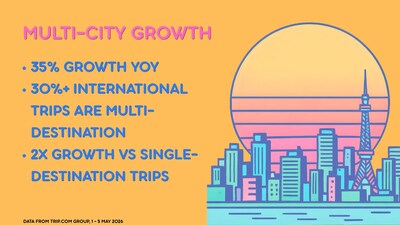
SINGAPORE, April 30, 2026 /PRNewswire/ -- Multi-city travel across Asia-Pacific grew 35% year-on-year this Labour Day period, according to data from Trip.com Group. Several Asia-Pacific markets including Japan, South Korea, parts of Southeast Asia and Mainland China celebrate Labour Day, driving strong cross-border and domestic travel flows across the region.
Over 30% of international trips now span multiple destinations, highlighting a continued shift towards more complex, itinerary-led travel. This shift reflects a growing preference to maximise time and value with multiple destinations within a single trip rather than a single location.
Multi-destination trips become a defining travel pattern
While single-destination travel continues to account for most bookings, growth is increasingly driven by more complex itineraries. Multi-destination bookings are growing at more than twice the pace of single-destination travel, reflecting stronger demand for flexibility and deeper exploration.
Travellers are increasingly structuring trips across multiple cities to maximise both time and value, with popular combinations including:
These itineraries reflect a growing preference for multi-stop journeys that blend urban experiences with leisure destinations.
Southeast Asia sees fast growth in multi-destination travel
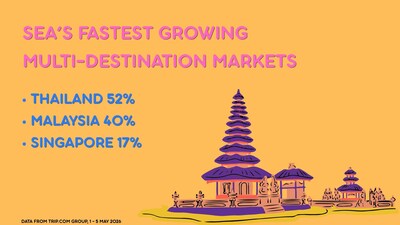
Across Southeast Asia, demand for multi-destination travel is rising steadily, with strong growth across key markets of Thailand: 52%, Malaysia: 40%, and Singapore: 17%, according to Trip.com Group data.
Top outbound destinations across Southeast Asian markets include Japan (Tokyo, Osaka), South Korea (Seoul), China (Shanghai, Beijing), Thailand (Bangkok), Indonesia (Bali).
In other parts of Asia such as Hong Kong SAR, multi-destination travel also grew by over 50% year-on-year, highlighting growing preference for more complex itineraries over traditional single-destination trips, particularly in well-connected urban markets.
In Mainland China, domestic travel remains a strong base, while overseas journeys are increasingly shaped by multi-destination itineraries, with over 40% of outbound trips spanning multiple destinations and continuing to grow.
This suggests that travellers in this region are increasingly combining multiple cities within a single trip, supported by strong regional connectivity.
Japan's domestic travel momentum on the rise
Japan is also seeing shifts in domestic travel behaviour, even as outbound demand continues to grow.
In Japan, domestic travel is growing rapidly, indicating rising interest in travelling within the country, accounting for one-quarter of all flight bookings, and to cities such as Tokyo, Sapporo and Okinawa.
Intra-Asia travel dominates Labour Day demand
The Labour Day holiday period continues to be driven by regional travel within Asia-Pacific, with travellers favouring destinations that offer ease of access, diverse experiences, and flexible itineraries.
The Group's data highlights the continued strength of short-haul travel, supported by strong connectivity and shorter flight durations.
More broadly, the way people travel across Asia-Pacific is evolving. Travellers taking a more deliberate approach to how they plan their trips. While cross-border journeys are increasingly shaped by multi-city itineraries, domestic travel remains a strong and steady part of the landscape. Together, these patterns point to a more flexible and value-conscious mindset, as travellers look to make the most of both time and budget.
About Trip.com Group
Trip.com Group is a leading global travel service provider comprising of Trip.com, Ctrip, Skyscanner, and Qunar. Across its platforms, Trip.com Group helps travellers around the world make informed and cost-effective bookings for travel products and services and enables partners to connect their offerings with users through the aggregation of comprehensive travel-related content and resources, and an advanced transaction platform consisting of apps, websites and 24/7 customer service centres. Founded in 1999 and listed on NASDAQ in 2003 and HKEX in 2021, Trip.com Group has become one of the best-known travel groups in the world, with the mission "to pursue the perfect trip for a better world". Find out more about Trip.com Group here: group.trip.com.
Follow us on: X, Facebook, LinkedIn, and YouTube.

Photo - https://mma.prnewswire.com/media/2968699/image1.jpg
Photo - https://mma.prnewswire.com/media/2968701/image2.jpg
Photo - https://mma.prnewswire.com/media/2968700/image3.jpg
Logo - https://mma.prnewswire.com/media/2919909/5944076/Trip_com_Group_Logo.jpg
 View original content:https://www.prnewswire.co.uk/news-releases/multi-destination-travel-surges-across-asia-pacific-this-labour-day-tripcom-group-data-shows-302757407.html

Wie stark der Verkehr in einer Stadt stockt, hängt weit weniger allein von der Leistungsfähigkeit des Strassennetzes ab als bislang angenommen. Eine Studie der ETH Zürich und der University of Wisconsin, veröffentlicht in der Fachzeitschrift «Nature Communications», zeigt: Entscheidend ist, wie Wohn-, Arbeits- und Freizeitquartiere räumlich angeordnet sind. Die Forschenden um den Geoinformatiker Yatao Zhang haben 30 Grossstädte weltweit – von Singapur bis Zürich – miteinander verglichen und dabei nicht nur Knotenpunkte und Verkehrsströme auf Strassen, sondern auch Bebauungsdichte, Quartiersstrukturen, Grünflächen und die Nutzung von Flächen für Wohnen, Einkauf, Sport, Verwaltung oder Bildung ausgewertet.
Für ihre Analyse griffen die Wissenschaftlerinnen und Wissenschaftler auf Staudaten des niederländischen Unternehmens Here Technologies zurück, das Bewegungsdaten von Fahrzeugen im Fünf-Minuten-Takt erfasst. Mit einer eigens entwickelten Methode konnten sie die wechselseitige Beeinflussung von Stadtmerkmalen und Verkehr über die Zeit hinweg beschreiben und erstmals robuste Ursache-Wirkung-Beziehungen identifizieren. Demnach führt etwa eine zersiedelte Stadtstruktur tendenziell zu mehr Verkehr, weil Distanzen länger werden und Alltagswege häufiger mit dem Auto zurückgelegt werden. Umgekehrt kann eine Mischnutzung von Wohnen und Arbeiten die Pendlerstrecken verkürzen und das Verkehrsaufkommen senken.
Die Befunde lassen sich konkret illustrieren: Ballungen von Freizeit- und Einkaufsangeboten in einzelnen Quartieren erhöhen den Wochenendverkehr, etwa durch Sportanlagen oder grosse Einkaufszentren. In Singapur etwa verstärkt die räumliche Trennung von grossen Wohngebieten und einem Dienstleistungszentrum die Kopplung zwischen Städtebau und Pendlerströmen deutlich. In Zürich ist dieser Zusammenhang laut Studie weniger ausgeprägt. «Verkehr entsteht durch das, was Menschen tun, nicht allein durch die Existenz von Strassen», fasst Erstautor Zhang die Ergebnisse zusammen.
Aus Sicht der Forschenden könnte die neue Methode mittelfristig die Stadt- und Verkehrsplanung beeinflussen. Werden die Erkenntnisse mit Detailstudien einzelner Städte kombiniert, lassen sich Szenarien simulieren: So kann etwa abgeschätzt werden, wie sich der Ausbau eines S-Bahn-Netzes auf Wohnungsbau in der Agglomeration auswirkt – und umgekehrt, wie ein rascher Anstieg von Neubauten in Vororten den Bedarf an zusätzlicher Verkehrsinfrastruktur nach sich zieht. Angesichts immer komplexerer Städte und wachsender Belastung der Verkehrssysteme sehen die Autorinnen und Autoren ein zentrales Ziel darin, Mobilität und Stadtentwicklung gemeinsam zu denken, um urbane Zentren nachhaltiger gestalten zu können.