XI'AN, China, April 25, 2026 /PRNewswire/ -- Taiyang News, a globally authoritative photovoltaic media outlet, officially released its April 2026 edition of the "TOP SOLAR MODULES LISTING". LONGi's EcoLife series modules (LR7-54HJD-510M), built on HIBC technology, have firmly claimed the top spot with a mass production efficiency of 25%. This milestone marks international recognition of LONGi's innovation strength in the back-contact (BC) technology pathway and ushers in a new "25%+" era for PV module efficiency.
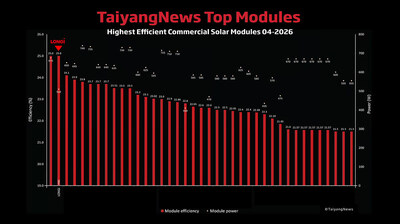
Since 2022, Taiyang News has published its monthly "TOP SOLAR MODULES Listing," now widely recognized as an authoritative efficiency ranking in the global PV industry. The ranking imposes stringent inclusion criteria: only products that have achieved large-scale mass production, have complete technical data, and deliver conversion efficiency of ≥21.5% are considered. Moreover, all data must come from commercial products already delivered to end customers. With "real and deliverable" as its baseline, the ranking holds high industry reference value and credibility, serving as a barometer for global PV module efficiency levels. LONGi's top position proves that its HIBC products have reached the world's highest efficiency in real mass production.
Behind this achievement lies LONGi's persistent efforts in BC technology. HIBC (High-temperature/Low-temperature Hybrid Interdigitated Back-Contact) cell technology is a major innovation along LONGi's BC roadmap. It combines the high passivation performance of heterojunction (HJT) technology with the superior light utilization of the back-contact structure, achieving the world's first mass production of such modules. In April 2025, the ISFH (Institute for Solar Energy Research in Hamelin) certified LONGi's HIBC cell efficiency at 27.81%, setting a new world record for this technology and approaching the theoretical limit of single-crystalline silicon cells.
Li Zhenguo, Founder and Chief Technology Officer of LONGi, commented: "This is another peak that LONGi has reached in technological innovation, as well as another major breakthrough in our BC technology journey. We have taken PV module efficiency to a significantly higher level, fully demonstrating the high scalability of BC technology and the substantial room for further efficiency gains."
The EcoLife series modules, designed specifically for residential applications, deliver a maximum power output of up to 510W. The EcoLife series modules increase the cell-to-module area ratio from 93.2% to 95.1%, thereby significantly enhancing light absorption. To address shading issues, the modules feature a unique quasi-bypass diode structure that enables current routing. Under shading, power loss is reduced by more than 70% compared to TOPCon products, making them highly resistant to soiling and shadows. With a leading power density of 250W/m², the modules effectively solve the challenge of generating more power on limited roof areas, substantially reducing household electricity costs.
Martin Green, known as the "Father of PV" and a professor at the University of New South Wales in Australia, has praised the technology: "On the 'Solar Cell Efficiency Tables' list, LONGi's HIBC technology dominates, taking the number one spot. This is also attributable to LONGi's persistent efforts on the BC technology track."
To date, LONGi's HIBC and BC series modules have gained extensive market validation worldwide. In January 2026, the LONGi EcoLife won the German Excellence Award 2026 in the "Energy & Environment" category. The jury's citation read: "LONGi EcoLife: Higher Power Generation, Higher Safety – Modules for an Uncertain Climate Future," specifically acknowledging the product's technical leadership and application value. In February, LONGi renewed a three-year framework agreement with Energy 3000, a well-known European energy solutions provider, to continuously supply a total of 2GW of high-efficiency PV modules, focusing on HPBC 2.0 and LONGi EcoLife modules based on HIBC technology.
At present, HIBC cell technology has already achieved large-scale mass production. LONGi has built a complete BC technology matrix ranging from HPBC 2.0 to HIBC. Moving forward, LONGi will continue to drive technological innovation, further boost module efficiency and power density through its BC technology platform, deepen global market applications of high-efficiency products such as HIBC, and strive to deliver more valuable clean energy solutions to customers worldwide, contributing to the global energy transition and the realization of carbon neutrality goals.
Photo - https://mma.prnewswire.com/media/2965335/image1.jpg
 View original content:https://www.prnewswire.co.uk/news-releases/longi-ecolife-series-module-top-taiyangnews-global-ranking-ushering-in-the-25-era-of-photovoltaic-efficiency-302753549.html

Die Aktionäre der Bossard Holding AG setzen weiter auf Verlässlichkeit bei der Ausschüttung: Die Generalversammlung des Innerschweizer Verbindungstechnik-Spezialisten hat am 10. April 2026 eine unveränderte Dividende von 3.90 Franken je Aktie für das Geschäftsjahr 2025 beschlossen. Im Vergleich zum Vorjahr bleibt der Betrag pro Titel damit stabil, während sich die gesamte Ausschüttungssumme dennoch leicht verringert. Bossard zahlt insgesamt 30.06 Millionen Franken an seine Anteilseigner aus – ein Rückgang um 2.43 Prozent gegenüber dem Vorjahr.
Am Tag der Hauptversammlung schloss die Bossard-Aktie an der SIX Swiss Exchange bei 156.00 Franken. Seit Montag wird das Papier ex Dividende gehandelt, was optisch zu teils deutlichen Kursabschlägen führen kann, ohne dass sich an den fundamentalen Daten unmittelbar etwas ändert. Auf Basis des beschlossenen Ausschüttungsbetrags ergibt sich für 2025 eine Dividendenrendite von 2.49 Prozent. Damit ist die Rendite höher als im Vorjahr, als sie 2.04 Prozent betrug – ein Effekt, der auch auf den gefallenen Aktienkurs zurückzuführen ist.
Die Kursentwicklung der vergangenen Jahre fällt für Investoren ernüchternd aus: Auf Drei-Jahres-Sicht hat die Bossard-Aktie rund 33.05 Prozent an Wert eingebüsst. Einschliesslich Dividenden summiert sich die tatsächliche Rendite auf minus 30.33 Prozent und liegt damit leicht über der reinen Kursentwicklung, bleibt aber deutlich im negativen Bereich. An der Börse kommt das Unternehmen derzeit auf eine Marktkapitalisierung von 1.202 Milliarden Franken. Auf Basis der aktuellen Bewertung weist Bossard ein Kurs-Gewinn-Verhältnis von 16.79 auf.
Operativ bleibt der Blick auf den Geschäftsverlauf gerichtet. Das Unternehmen hat für den 10. April eine Ad-hoc-Mitteilung zum Umsatz im ersten Quartal 2026 nach Richtlinie Art. 53 des Kotierungsreglements veröffentlicht. Details sind über die Investor-Relations-Seite von Bossard abrufbar. Im Geschäftsjahr 2025 erzielte die Gruppe einen Umsatz von 1.069 Milliarden Franken. Parallel dazu signalisieren Analysten Vertrauen in die Ausschüttungsfähigkeit: Laut FactSet-Prognosen dürfte die Dividende für 2026 auf 4.25 Franken steigen, was einer geschätzten Dividendenrendite von 2.71 Prozent entspräche.
Mit der Kombination aus stabiler Dividende, moderater Bewertung und schwacher historischer Kursbilanz positioniert sich Bossard als klassischer Qualitätswert mit Ertragsfokus, dessen weitere Entwicklung eng von der Nachfrage im Industrie- und Fertigungssektor abhängen dürfte. Wie stark sich der jüngste Quartalsumsatz und das konjunkturelle Umfeld auf Margen und Ausschüttungspolitik auswirken, werden die kommenden Berichtsperioden zeigen.