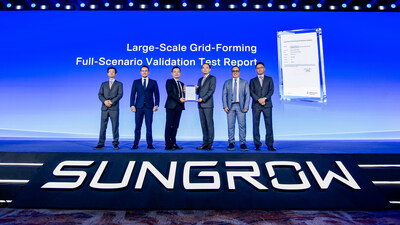
HEFEI, China, April 28, 2026 /PRNewswire/ -- Sungrow, the globally leading PV inverter and energy storage system provider, successfully completed the world's first large-scale grid-forming full-scenario validation. The program covered 14 scenarios over 138 hours and was independently witnessed and verified by TÜV Rheinland. All results met multiple international standards, confirming reliable operation under complex grid conditions.
As global power systems rapidly transition toward high shares of renewable energy, grid stability is becoming a critical challenge. The test base features a world-leading 30MW grid simulation platform, along with the real short-circuit capacity regulation equipment and advanced arc-fault testing devices, enabling the replication of complex and extreme grid conditions at full scale. These tests align with grid codes and requirements across major global markets, including Europe, Australia, and China, addressing growing challenges related to grid stability and high renewable penetration worldwide.
Validated Performance Across Main Critical Grid Scenarios
A short-circuit test was conducted using real arc-fault equipment to simulate the most severe fault conditions. Under identical fault scenarios, the grid-forming system remained connected and continuously supplied fault current, while conventional systems are more likely to disconnect.
Key advantages:
Response time as fast as 10 ms
Stable and continuous fault current contribution
Strong fault ride-through capability
Compared with conventional grid-following systems, which may lose stability under the same disturbance, Sungrow's solution maintained continuous operation and restored frequency stability within milliseconds.
Key advantages:
Millisecond-level response to frequency deviations
Stable operation under sudden disturbances
Improved system resilience in weak grids
In a full blackout test, all external power was disconnected from the site. During this test, Sungrow's grid-forming PCS (Power Conversion System) established system voltage within 19 seconds, then successfully restarted the entire facility, restoring loads and infrastructure without external support. This capability enables industry-leading GW-scale black start and significantly enhances system restoration speed.
Key advantages:
Faster restoration
GW-scale black-start capability
virtually no circulation current
In addition to the three tests mentioned above, another eleven tests including on/off-grid switching, load switching, and oscillation damping were also successfully completed.
As demand for grid-forming technologies continues to grow, validating their real-world performance is becoming increasingly important. Reliance solely on digital power system simulations is not sufficient, while live testing provides more reliable and real validation. "Based on two decades of experience on grid-forming technology and in-depth understanding of power system stability requirements, Sungrow has built a 30 MW large-scale simulation platform and conducted 14 comprehensive real-world extreme test scenarios," said Henry Liu, General Manager of the Microgrid and Grid Solutions Center at Sungrow. "These results demonstrate grid-forming capabilities and mark a critical step toward the large-scale deployment of grid-forming technologies."
Sungrow will continue to advance the development of evaluation frameworks and industry standards, supporting broader adoption and enabling more stable, resilient power systems worldwide.
About Sungrow
Sungrow, a global leader in renewable energy technology, has pioneered sustainable power solutions for over 29 years. As of Dec 2025, Sungrow has installed over 1000 GW of power electronic converters worldwide. The company is recognized as the world's most bankable PV inverter and energy storage company (BloombergNEF). Its innovations power clean energy projects across the globe, supported by a network of 520 service outlets guaranteeing excellent customer experiences. At Sungrow, we're committed to bridging to a sustainable future through cutting-edge technology and unparalleled service. For more information, please visit: www.sungrowpower.com/en
Contact:
luly.wang@sungrow-hq.com

Photo - https://mma.prnewswire.com/media/2967535/Large_Scale_Grid_FormingFull_Scenario_Validation_Test_Report.jpg
Logo - https://mma.prnewswire.com/media/1344575/Logo.jpg
 View original content:https://www.prnewswire.co.uk/news-releases/beyond-simulation-sungrow-completes-worlds-first-large-scale-full-condition-grid-forming-extreme-test-302755374.html

Die Aktionäre der Bossard Holding AG setzen weiter auf Verlässlichkeit bei der Ausschüttung: Die Generalversammlung des Innerschweizer Verbindungstechnik-Spezialisten hat am 10. April 2026 eine unveränderte Dividende von 3.90 Franken je Aktie für das Geschäftsjahr 2025 beschlossen. Im Vergleich zum Vorjahr bleibt der Betrag pro Titel damit stabil, während sich die gesamte Ausschüttungssumme dennoch leicht verringert. Bossard zahlt insgesamt 30.06 Millionen Franken an seine Anteilseigner aus – ein Rückgang um 2.43 Prozent gegenüber dem Vorjahr.
Am Tag der Hauptversammlung schloss die Bossard-Aktie an der SIX Swiss Exchange bei 156.00 Franken. Seit Montag wird das Papier ex Dividende gehandelt, was optisch zu teils deutlichen Kursabschlägen führen kann, ohne dass sich an den fundamentalen Daten unmittelbar etwas ändert. Auf Basis des beschlossenen Ausschüttungsbetrags ergibt sich für 2025 eine Dividendenrendite von 2.49 Prozent. Damit ist die Rendite höher als im Vorjahr, als sie 2.04 Prozent betrug – ein Effekt, der auch auf den gefallenen Aktienkurs zurückzuführen ist.
Die Kursentwicklung der vergangenen Jahre fällt für Investoren ernüchternd aus: Auf Drei-Jahres-Sicht hat die Bossard-Aktie rund 33.05 Prozent an Wert eingebüsst. Einschliesslich Dividenden summiert sich die tatsächliche Rendite auf minus 30.33 Prozent und liegt damit leicht über der reinen Kursentwicklung, bleibt aber deutlich im negativen Bereich. An der Börse kommt das Unternehmen derzeit auf eine Marktkapitalisierung von 1.202 Milliarden Franken. Auf Basis der aktuellen Bewertung weist Bossard ein Kurs-Gewinn-Verhältnis von 16.79 auf.
Operativ bleibt der Blick auf den Geschäftsverlauf gerichtet. Das Unternehmen hat für den 10. April eine Ad-hoc-Mitteilung zum Umsatz im ersten Quartal 2026 nach Richtlinie Art. 53 des Kotierungsreglements veröffentlicht. Details sind über die Investor-Relations-Seite von Bossard abrufbar. Im Geschäftsjahr 2025 erzielte die Gruppe einen Umsatz von 1.069 Milliarden Franken. Parallel dazu signalisieren Analysten Vertrauen in die Ausschüttungsfähigkeit: Laut FactSet-Prognosen dürfte die Dividende für 2026 auf 4.25 Franken steigen, was einer geschätzten Dividendenrendite von 2.71 Prozent entspräche.
Mit der Kombination aus stabiler Dividende, moderater Bewertung und schwacher historischer Kursbilanz positioniert sich Bossard als klassischer Qualitätswert mit Ertragsfokus, dessen weitere Entwicklung eng von der Nachfrage im Industrie- und Fertigungssektor abhängen dürfte. Wie stark sich der jüngste Quartalsumsatz und das konjunkturelle Umfeld auf Margen und Ausschüttungspolitik auswirken, werden die kommenden Berichtsperioden zeigen.