HONG KONG, June 12, 2026 /PRNewswire/ -- As global air cargo hubs confront rising e-commerce demand, labour shortages, and decarbonisation targets, Westwell—a global AI company advancing smart and green container logistics—is applying its "AI + New Energy (Ainergy)" strategy to airport operations. Serving over 200 customers across 30+ economies, Westwell now brings its AI-Native capabilities to air cargo, seaport, rail, land transport, and smart factories.
At the core is a dual-AI architecture: Physical AI enables frontline autonomous execution, while Operational AI drives intelligent decision-making.
Designed for demanding airside conditions, Westwell's Q-Tractor is powered by the self-developed Q-Pilot autonomous driving platform, integrating BEV perception and Transformer-based end-to-end models. Redundant safety architectures ensure 24/7 reliability in all weather and visibility conditions. Centimetre-level automatic trailer coupling and uncoupling—validated across multiple airport deployments—closes the last gap in unmanned logistics, enabling autonomous cargo loading and unloading. Powered by pure electric drive, the Q-Tractor achieves zero emissions in core operations.
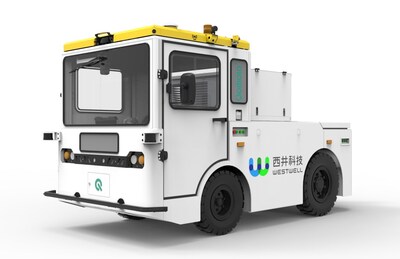
On the Operational AI layer, the ReeWell intelligent operations management platform, together with the WellFMS fleet management system, provides real-time dispatching, route optimisation, and coordinated decision-making across flights, cargo, vehicles, and energy resources—maximising fleet efficiency and capacity utilisation.
Westwell's solutions are being deployed at key air cargo hubs including Hong Kong International Airport, Hong Kong Air Cargo Terminals Limited (Hactl), Shanghai Pudong International Airport, Ezhou Huahu International Airport, and newly secured projects at Fuzhou Changle International Airport and Xiamen Xiang'an International Airport.
In 2025, Westwell officially received approval to deploy new energy autonomous tractors at Hactl - the largest independent air cargo handler in Hong Kong. Westwell's Q-Tractors power unmanned cargo transportation operations at the terminal, enhancing productivity while accelerating Hactl's smart and green transformation.
At Shanghai Pudong International Airport, Westwell is expanding AI applications into airport safety operations beyond cargo transportation - the company is developing an industry-leading "AI + Autonomous Driving + FOD Detection" intelligent runway inspection solution, combining autonomous vehicles, radar systems and AI recognition algorithms to support the safe operation of flights.
As airports continue balancing efficiency, resilience and sustainability targets, AI-Native operational systems are expected to play an increasingly strategic role in air cargo infrastructure development. For Westwell, the future of airport logistics lies not simply in automation, but in building collaborative ecosystems where people, intelligent vehicles and AI systems work together more safely, efficiently and sustainably.
Photo - https://mma.prnewswire.com/media/2996737/image2.jpg
 View original content:https://www.prnewswire.co.uk/news-releases/westwell-rebuilding-air-cargo-operations-through-ai-native-logistics-302798822.html

Der Standortentscheid ist gefallen: Hitachi Energy baut seinen neuen Schweizer Hauptsitz nicht in Wettingen AG, sondern in Otelfingen im Kanton Zürich. Der international tätige Technologiekonzern will auf einem Campus das bisher über zwölf Standorte verteilte Geschäft in der Schweiz konzentrieren und dort langfristig rund 3000 Arbeitsplätze ansiedeln. Bereits heute sichert das Unternehmen nach eigenen Angaben 1000 Stellen, zusätzlich sollen auf dem neuen Areal bis zu 2000 weitere Jobs entstehen.
Otelfingen setzt sich damit gegen die Aargauer Gemeinde Wettingen durch, die auf der «grünen Wiese» im Gebiet Tägerhardächer auf die Ansiedlung gehofft hatte. Statt eines kompletten Neubaus nutzt Hitachi in Otelfingen das ehemalige, teils unter Schutz stehende Jelmoli-Verteilzentrum sowie angrenzende Parzellen – insgesamt 11 Hektaren. Ausschlaggebend waren nach Angaben der Beteiligten unter anderem die bestehende S-Bahn-Haltestelle direkt beim Areal, die Möglichkeit einer etappierten Entwicklung des Projekts sowie die Risikoabwägung zwischen Umnutzung bestehender Bausubstanz und einem Neubau.
Für Otelfingen markiert der Entscheid einen Einschnitt von historischer Dimension: Die Gemeinde vergleicht die Ansiedlung der Energie-Sparte von Hitachi mit dem Zuzug von Jelmoli in den 1960er-Jahren. Der Campus soll zunächst mit rund 1600 Arbeitsplätzen starten und später auf bis zu 3000 ausgebaut werden. Hitachi Energy plant, bis 2030 die heutigen Standorte in Baden, Dättwil, Turgi-Untersiggenthal, Seon und Zürich-Altstetten in Otelfingen zu bündeln. Der Konzern bekräftigt, die Schweiz bleibe ein entscheidendes Zentrum für die Weiterentwicklung seiner Technologien.
Im Aargau überwiegen Enttäuschung und Sorge. Rund 1000 Arbeitsplätze gehen dem Kanton mit der Verlagerung verloren, wie die Standortförderung bestätigt. Wettingen hatte sich von dem Projekt nicht nur Impulse für das wirtschaftlich angeschlagene Gemeinwesen, sondern auch bis zu zweistellige Millionenerträge pro Jahr in der Gemeindekasse erhofft. Gleichzeitig war das Vorhaben politisch umstritten: Für den geplanten Campus hätte Landwirtschaftsland umzoned werden müssen, wogegen sich insbesondere die Nachbargemeinde Würenlos stellte und unter anderem steigende Immobilienpreise und mehr Verkehr befürchtete. Dass nun Otelfingen mit bestehender Infrastruktur und höherer Unternehmenssteuerbelastung den Zuschlag erhält, verschiebt das wirtschaftliche Gewicht in der Region Limmattal zugunsten des Kantons Zürich.