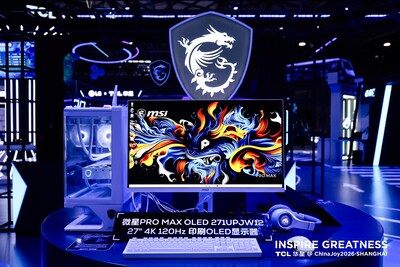
SHANGHAI, Aug. 3, 2026 /PRNewswire/ -- TCL CSOT and MSI today unveiled the world's first 27‑inch 4K 120Hz Inkjet-printed (IJP) OLED high‑end professional desktop monitor at ChinaJoy 2026. Delivering clearer and more detailed visuals across a range of use cases, the new display leverages IJP OLED technology to usher in the next generation of professional displays for office work, content creation and multimedia entertainment.

The launch marks TCL CSOT's first entry into the mid‑size IJP OLED desktop monitor segment for consumer applications, building on the company's established mass production of IJP OLED panels for medical-specific uses.
MSI Unveils The First High-End 27" 4K 120Hz IJP OLED Desktop Monitor
Powered by TCL CSOT's IJP OLED display solution, the MSI PRO MAX OLED 271UPJW12 features a 27‑inch 4K 120Hz panel with vertical RGB stripe pixel arrangement. Unlike conventional OLED displays, this architecture closely resembles traditional LCDs, effectively eliminating color fringing around text and image edges to deliver pixel-sharp text clarity. Color performance is just as impressive, with 99% DCI‑P3 wide color gamut coverage, Delta E ≤ 2 color accuracy, and VESA DisplayHDR True Black 500 certification. With 1,000 nits HDR peak brightness and OLED's inherent infinite contrast ratio, the display delivers deep, pure blacks and well-defined, richly detailed highlights. 164 PPI pixel density meanwhile ensures exceptional sharpness for both color‑critical creative workflows and immersive visual entertainment.
Beyond visual performance, the monitor introduces MSI's OLED Auto Care full-time protection technology—a pioneering invisible background maintenance system and the world's first uninterrupted OLED protection on a monitor. Supporting real‑time Data Counting Compensation (DCC), which runs fully automatically and seamlessly in the background, the new solution eliminates disruptions caused by traditional forced protection mechanisms. The result is a zero pop‑up and interruption-free experience that lets users stay locked into their workflow and more immersed in gaming. The monitor also streamlines multi‑device setups with an integrated KVM switch, PIP/PBP modes, and a USB‑C interface with 15W Power Delivery. An ergonomic stand with height, tilt, swivel, and pivot adjustment further allows users to create comfortable workspaces tailored to different applications.
Visual health is also at the core of the new monitor. The IJP OLED panel has earned Eyesafe® 3.0 certification for natively limiting harmful blue light emissions to 20% or below and also meets the Circadian Protection Factor (CPF) standard designed to reduce the impact of nighttime screen use on sleep patterns. At the system level, the PRO MAX OLED 271UPJW12 features hardware level TÜV‑certified low blue light and flicker‑free, ensuring visual comfort throughout extended use.
To further enhance everyday practicality, the panel incorporates an upgraded anti‑glare (AG) coating that increases surface hardness from 2H to 3H, boosting scratch resistance by up to 2.5× while minimizing glare and reflections.
MSI Showcases Star Gaming Products at TCL CSOT Booth
In addition to the new 27‑inch 4K 120Hz IJP OLED professional desktop monitor, the TCL CSOT and MSI booth also showcased a range of flagship MSI gaming products, including the MSI Claw 8 EX AI+ handheld console 2026, featuring an 8‑inch WU 120Hz display; the MSI Raider 16 HX 2026 gaming laptop, equipped with a 16‑inch WQ 240Hz display; and the MSI Crosshair 18 HX 2026 gaming laptop, featuring an 18‑inch WQ 240Hz display. Through these product collaborations and more, the two companies are leading the next wave in gaming display development.
Whether through panel technologies like IJP OLED, HVA and HFS, or emerging AI-driven solutions for lower power consumption and visual health, TCL CSOT continues to leverage its extensive catalogue of display technologies to deliver state-of-the-art solutions that address evolving user demands across diverse product categories. From faster refresh rates and response times to true-to-life picture quality and improved visual comfort, TCL CSOT is working with partners to transform cutting-edge display technologies into real end-user experiences across gaming laptops, handheld consoles, gaming monitors, high-end professional displays and more, together driving new improvements in picture quality and user experiences in even more scenarios.


Logo - https://mma.prnewswire.com/media/3008575/logo_Logo.jpg
Photo - https://mma.prnewswire.com/media/3008580/1.jpg
Photo - https://mma.prnewswire.com/media/3008576/2.jpg
Photo - https://mma.prnewswire.com/media/3008578/4.jpg
 View original content:https://www.prnewswire.co.uk/news-releases/tcl-csot-and-msi-join-forces-to-launch-worlds-first-27-4k-120hz-ijp-oled-high-end-professional-monitor-at-chinajoy-2026-302840880.html

Der US-Datenkonzern Palantir hat in der Schweiz eine deutliche juristische Niederlage erlitten. Das Handelsgericht Zürich wies 22 von 23 beanstandeten Passagen in zwei kritischen Artikeln des Online-Magazins «Republik» zurück. Lediglich eine einzelne Formulierung muss die Redaktion korrigieren. Palantir und seine Schweizer Tochtergesellschaft wollten gerichtlich durchsetzen, dass umfangreiche Gegendarstellungen publiziert werden; dieses Anliegen ist nun weitgehend gescheitert. Nach dem Urteil muss der Konzern zudem den überwiegenden Teil der Verfahrenskosten tragen.
Ausgangspunkt des Rechtsstreits waren Recherchen, die im Dezember 2025 nach rund einjähriger Arbeit erschienen. Das Projekt von «Republik» und dem Recherchekollektiv WAV beleuchtete, wie Palantir über mehrere Jahre versucht hatte, bei Bundesstellen und dem Schweizer Militär Aufträge zu erhalten – ohne Erfolg. Die Journalisten werteten dazu Dutzende Gesuche nach dem Öffentlichkeitsgesetz sowie interne Unterlagen aus und kamen zum Befund, dass das Unternehmen trotz einer mehrjährigen Präsenz in der Schweiz keinen einzigen Regierungsauftrag gewinnen konnte. Diese Erzählung eines «Scheiterns» auf dem Schweizer Markt war nach Darstellung der beteiligten Reporter Auslöser für Palantirs juristische Offensive.
Die Redaktion hatte dem Unternehmen nach eigenen Angaben vor Veröffentlichung ausführliche Fragen geschickt und Führungskräfte interviewt. Palantir verlangte darüber hinaus eine detaillierte, punktweise Replik im Magazin, die über den Umfang der ursprünglichen Recherche hinausgegangen wäre. Als «Republik» dies ablehnte, reichte der Konzern Klage ein. Das Zürcher Handelsgericht stellte nun klar, dass nur eine von 23 umstrittenen Passagen eine Gegendarstellung erfordert. Damit bestätigt das Urteil, dass der Großteil der Berichterstattung über Palantirs vergebliche Akquisitionsversuche bei Schweizer Behörden auf einer zulässigen Auswertung amtlicher Dokumente beruht.
Palantir ist international vor allem durch den Einsatz seiner Software in militärischen und nachrichtendienstlichen Kontexten bekannt. Seit 2022 stellt das Unternehmen Plattformen zur Verfügung, die ukrainische Behörden und Streitkräfte bei der Auswertung von Lagebildern, der Zielidentifikation und der Logistik unterstützen. Die Systeme werden außerdem von US-amerikanischen und verbündeten Diensten im Nahen Osten genutzt, um iranische Aktivitäten etwa in Raketenprogrammen, beim Einsatz von Drohnen oder in Cyberoperationen zu analysieren. Direkte Geschäftsbeziehungen mit dem Iran bestehen nach Unternehmensangaben aufgrund von US-Sanktionen nicht. Das Zürcher Urteil könnte über die Schweiz hinaus Signalwirkung haben, nachdem die Recherche bereits in anderen europäischen Staaten Debatten über Nutzen und Notwendigkeit der Palantir-Technologie im staatlichen Bereich angestoßen hatte.