SEOUL, South Korea, Sept. 17, 2026 /PRNewswire/ -- The Supreme Court of Singapore and the Supreme Court of Korea signed two new instruments aimed at supporting the effective resolution of cross-border civil and commercial disputes on 16 September 2026.
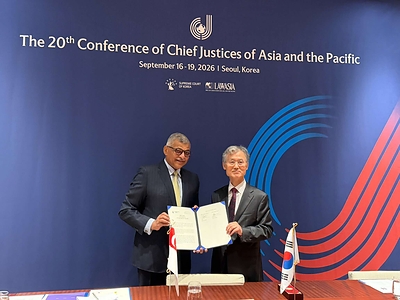
The Memorandum of Guidance as to the Enforcement of Money Judgments (MOG) and the Memorandum of Understanding on Cooperation Regarding Information on Foreign Law (MOU) were signed by The Honourable the Chief Justice Sundaresh Menon and Chief Justice Jo Hee-de of the Supreme Court of Korea. The signing took place in Seoul on the sidelines of the 20th Conference of Chief Justices of Asia and the Pacific, following a courtesy call between the two Chief Justices.
The MOG sets out the Singapore and Korean courts' understanding of the procedures and requirements for the recognition and enforcement of money judgments of one jurisdiction in the other. It covers judgments requiring payment of a sum of money and does not cover non-monetary relief or criminal orders, fines or penalties.
The MOG will serve as a practical reference for litigants and practitioners in cross-border cases by setting out the applicable legal requirements and procedures in both jurisdictions. This will provide greater clarity and understanding for parties seeking to a Singapore money judgment recognised and enforced in Korea, or a Korean money judgment recognised and enforced in Singapore.
Chief Justice Menon said: "A judgment may offer little real relief if it cannot be enforced where the judgment debtor or its assets are located. By explaining how our respective courts approach the recognition and enforcement of money judgments, the Memorandum will promote greater clarity, certainty and confidence for litigants."
The MOU establishes a mechanism for the Singapore and Korean courts to exchange information on their respective domestic laws and judicial practices in civil and commercial matters. It applies where a court is required to consider the law of the other jurisdiction in an ongoing international civil or commercial case.
Through the MOU, the Singapore and Korea courts will have a clearer and more efficient channel for obtaining reliable information on each other's laws and judicial practices in cross-border civil and commercial cases. Information exchanged may include relevant legislation, judicial precedents, decisions, interpretations and court orders. This will support the courts in determining questions of foreign law more accurately and efficiently.
For more details, visit News and speeches (judiciary.gov.sg)
 View original content to download multimedia:https://www.prnewswire.co.uk/news-releases/supreme-courts-of-singapore-and-korea-sign-new-arrangements-to-support-cross-border-civil-and-commercial-disputes-302881863.html

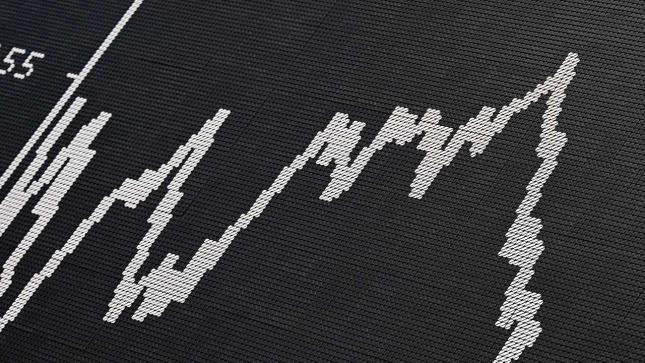
Inflationssorgen und steigende Ölpreise haben Europas wichtigste Aktienmärkte zur Wochenmitte spürbar belastet und zugleich die Monatsbilanz eingetrübt. Der EuroStoxx 50 schloss am Mittwoch 0,81 Prozent tiefer bei 6269,02 Punkten. Im Monatsverlauf verlor der Leitindex der Eurozone 2,4 Prozent und beendete damit eine Serie von fünf Anstiegen in Folge. Der DAX gab um 0,79 Prozent auf 25.199,19 Punkte nach, während der britische FTSE moderat um rund ein Viertel Prozent auf gut 10.600 Zähler nachgab.
Treiber der Risikoaversion waren neue Inflationsdaten aus großen Euroländern. In Deutschland kletterten die Verbraucherpreise im September auf 3,3 Prozent gegenüber dem Vorjahr und damit erstmals seit Ende 2023 wieder über die Marke von drei Prozent, nachdem im August noch 2,9 Prozent verzeichnet worden waren. Starke Anstiege der Energiepreise wirkten als Hauptfaktor – eine Entwicklung, die sich nach ersten Angaben auch in Frankreich und Italien widerspiegelt. In Italien kam es zudem zu einem deutlichen Anstieg der Teuerung, was die Sorge nährte, dass der disinflationäre Trend im Euroraum ins Stocken geraten könnte.
Parallel dazu zogen die Ölpreise erneut an. Marktteilnehmer verwiesen auf die angespannte geopolitische Lage im Nahen Osten und mögliche Risiken für die Öllieferungen aus dem Persischen Golf. Berichte, wonach mehrere Tankschiffe in der Straße von Hormuz unter Beschuss geraten sein sollen, verstärkten die Nervosität. Höhere Energiekosten und im Umfeld der Inflationsdaten steigende Anleiherenditen machten Anleger nach Einschätzung von Marktstrategen europaweit selektiver. Ulrich Urbahn, Leiter Multi-Asset-Strategie und Research bei Berenberg, sieht dennoch Chancen für eine Jahresendrallye: Robuste Unternehmensgewinne könnten die Märkte stützen, sofern Firmen ihre Margen und Prognosen behaupten und sowohl Inflation als auch Renditen nicht weiter zulegen.
Im Branchenspektrum fehlten klare Impulse von den Technologiewerten, die nach Vortagesgewinnen überwiegend richtungslos tendierten. Viele Investoren warteten auf die anstehenden Quartalszahlen des US-Speicherchip-Herstellers Micron, die als Gradmesser gelten, ob der Boom rund um Künstliche Intelligenz weiterhin ausreichend im operativen Geschäft der Halbleiterbranche ankommt. Analyst Andreas Lipkow von CMC Markets warnte, eine Enttäuschung bei Micron könne die zuletzt gewachsene Skepsis gegenüber dem KI-Sektor rasch in neuen Verkaufsdruck umschlagen lassen. Einzelwerte wie BMW im DAX konnten sich diesem Umfeld zwar mit Kursgewinnen entziehen, insgesamt dominierte an den europäischen Börsen jedoch zum Monatsende die Vorsicht.