OSLO, Norway, July 23, 2026 /PRNewswire/ -- Public trust in health innovation may be less predictable than healthcare organizations assume, according to new research from DNV, the independent assurance and certification provider.
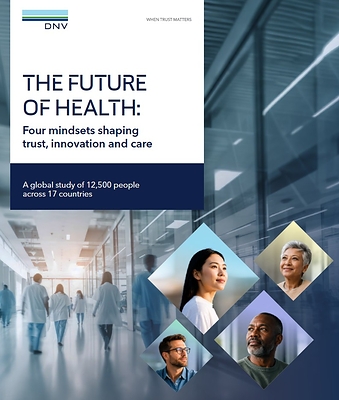
A global survey of 12,500 people across 17 countries found that mindset is a stronger indicator of trust than traditional demographic factors such as age, income or geography.
The findings, published in DNV's new report The Future of Health: Four mindsets shaping trust, innovation and care challenge conventional approaches to audience segmentation and identify four distinct trust mindsets that influence how people evaluate healthcare, innovation and the future of care.
With health ecosystems facing growing pressure from ageing populations, workforce shortages and rapidly advancing technologies, understanding what builds public confidence will become critical.
Contrary to popular belief, the report finds that trust cannot be explained through demographics alone. People with similar demographic profiles can hold very different attitudes towards innovation and the future of health. The report identified four distinct mindsets of people building trust in healthcare: Trusting Optimists, Human Connectors, Evidence Evaluators and Pragmatic Realists.
While Trusting Optimists are inclined to embrace new technologies that promise better outcomes and access to care, Human Connectors judge innovation through the lens of personal relationships and compassionate care. Evidence Evaluators look for transparency, accountability and proof that innovations deliver on their promises. The largest group identified in the research was Pragmatic Realists, people who judge innovation less by how advanced it is and more by whether it improves access, affordability and healthcare outcomes.
What makes these mindsets particularly significant is that they cut across traditional demographic boundaries. While age, income, health status and location all influence attitudes towards healthcare, they do not fully explain how people build trust. The research found, people with similar demographic profiles often belong to different trust mindsets, while people from very different backgrounds frequently share similar views on innovation and the future of care.
The findings also challenge common assumptions about age and technology. While older people are often viewed as more resistant to innovation and younger generations as more naturally accepting, the research suggests attitudes are shaped less by age than by people's experience of healthcare.
Across all four mindsets, one finding stood out. Nearly two-thirds of respondents, expressed concern that healthcare could become less personal as technology adoption accelerates, highlighting a shared expectation that innovation should strengthen and not replace the human experience of care.
The research suggests that people do not embrace innovation simply because it is new. Rather, confidence grows when technology is developed responsibly, assessed rigorously and implemented with patient outcomes in mind.
"Healthcare has never been innovating faster. But innovation alone won't determine the future of healthcare, trust will. Many assume trust is determined by age, gender or social status. Our research shows it's far more nuanced than that. Demographics influence trust, but do not define it." said Geir Fuglerud, CEO - Life Sciences at DNV. "The four mindsets we identify show that people build confidence in different ways, yet they share one important expectation: Technology should strengthen healthcare, not replace human care."
The report The Future of Health: Four mindsets shaping trust, innovation and care is available to download here.

 View original content to download multimedia:https://www.prnewswire.co.uk/news-releases/public-trust-in-health-innovation-is-shaped-more-by-mindset-than-demographics-dnv-research-finds-302833319.html

Forschende der Universität Zürich (UZH) haben einen Ansatz entwickelt, mit dem sich akuter Schlafmangel im Speichel nachweisen lässt. In einer aktuellen Studie identifizierte das Team um Thomas Krämer vom Institut für Rechtsmedizin eine Art metabolischen Fingerabdruck, der starke Übermüdung zuverlässig anzeigt. Die Resultate wurden im Fachmagazin „Journal of Proteome Research“ veröffentlicht und von Krämer als „Meilenstein für die forensische Forschung“ bezeichnet.
Für die Untersuchung rekrutierten die Wissenschaftler 20 gesunde junge Männer, die normalerweise sieben bis neun Stunden pro Nacht schlafen. Die Probanden durchliefen drei Szenarien: eine Nacht komplett ohne Schlaf, vier Nächte mit jeweils zwei Stunden weniger Schlaf als üblich sowie eine Kontrollbedingung mit rund acht Stunden Schlaf. Nach jeder Phase wurden Speichelproben entnommen und mittels hochauflösender Massenspektrometrie analysiert. Mithilfe von maschinellem Lernen suchte das Team nach molekularen Mustern, die spezifisch auf akuten Schlafentzug hinweisen.
Die Auswertung ergab, dass starke Übermüdung rund zehn Prozent aller Biomoleküle im Speichel beeinflusst. Aus zehntausenden gemessenen Molekülen filterten die Forschenden schließlich zehn spezifische Biomarker heraus, die als Signatur für akuten Schlafmangel dienen könnten. Diese erstmals im Speichel identifizierten direkten Marker für Übermüdung unter alltagsnahen Bedingungen gelten aus Sicht der UZH als Grundlage für neue diagnostische Verfahren.
Langfristig zielt das Projekt auf die Entwicklung eines Schnelltests, der vor Ort eingesetzt werden könnte – etwa im Strassenverkehr, in sicherheitskritischen Berufen oder bei der forensischen Abklärung von Unfällen. Die Forschenden betonen jedoch, dass es sich derzeit um eine Grundlagenstudie mit einer kleinen und homogenen Probandengruppe handelt. Bevor ein solcher Speicheltest in der Praxis Anwendung findet, seien umfangreichere Untersuchungen mit grösseren und vielfältigeren Bevölkerungsgruppen erforderlich.