NUREMBERG, Germany, March 10, 2026 /PRNewswire/ -- Nanopower Semiconductor, a European fabless semiconductor manufacturer, announces that their award winning nPZero power-saving integrated circuit (PSIC) is now in volume production enabling, original equipment manufacturers (OEMs) to move from evaluation to high-volume deployment in power-constrained Internet of Things (IoT) products. Nanopower's nPZero is a power-saving integrated circuit (PSIC) designed to reduce the energy consumption of battery-powered applications by up to 90%. Samples and development kits are immediately available.
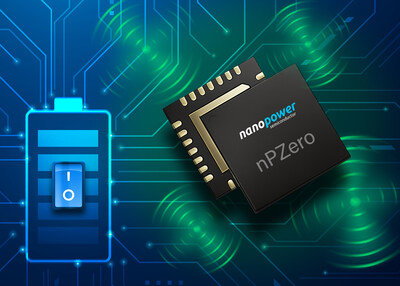
At Embedded World in Nuremberg, visitors can meet Nanopower Semiconductor at Hall 4 / Booth 4-460 to see nPZero in action and discuss design-in options and evaluation hardware. Nanopower will showcase demonstrations focused on battery-powered and energy-harvesting, helping embedded engineers extend operating life and reduce maintenance by keeping the microcontroller in deep sleep for longer periods.
Rewriting IoT power budgets: Meet nPZero
nPZero is a power-saving IC that enables always-on monitoring and control of sensors with the host microcontroller powered down. In operation, nPZero powers down the microcontroller, takes over the controller role, and autonomously handles power-up, configuration, and data reading from up to four sensors or other peripherals. The host is powered up, and control is returned when triggered by user-defined rules, allowing to remain off for long periods while the system continues to detect and respond to events.
nPZero is designed for battery-powered and energy-harvesting IoT devices where energy budgets limit sensing frequency, uptime, or maintenance intervals. Typical deployments include smart buildings, smart cities, and smart agriculture, as well as tracking, logging, and monitoring applications where devices must remain in the field for long periods and respond reliably to threshold events.
In a reference use case, nPZero has been empirically shown to significantly reduce current consumption for peripheral polling compared to a baseline system without nPZero. The measured system included a wireless microcontroller development kit plus a temperature sensor and a three-axis accelerometer.
Why energy efficiency is now a competitive advantage
Design teams building sensor-based IoT devices are under pressure to do more with less energy. In many systems, the microcontroller is woken frequently just to poll sensors, burning power even when nothing has changed. This creates a direct cost and operational burden as product fleets scale: shorter battery life, more maintenance visits, and tighter constraints on what can be measured, logged, or transmitted.
nPZero changes that system-level power profile by moving routine sensing and decision-making into an ultra-low-power companion IC, so products can remain responsive to real-world events without repeatedly waking the host processor.
To support fast evaluation and design-in, Nanopower provides access to the nPZero Configurator, which enables developers to adjust settings through a graphical user interface and automatically generate the necessary application programming interface (API) code, reducing manual bring-up effort.
For technical resources, visit the company website.
About Nanopower Semiconductor
Nanopower was founded based on the invention of the ultra-low-power nPZero technology in 2017 and has developed nPZero to create a scalable solution for high-volume IoT markets. The company is incorporated in Norway, with operations and offices in Kristiansand, Norway, and Porto, Portugal.
Photo - https://mma.prnewswire.com/media/2927203/Nanopower_NPZero.jpg
 View original content:https://www.prnewswire.co.uk/news-releases/nanopower-announces-volume-production-of-award-winning-npzero-power-saving-ic-for-battery-powered-and-energy-harvested-iot-302705705.html


Die Schweizer Genossenschaft Migros Zürich (GMZ) hat ihren vollständigen Rückzug aus dem deutschen Markt bekannt gegeben. Nach einer strategischen Neubeurteilung verkauft das Unternehmen die Supermarktkette Tegut, die es seit 2013 besaß. Ein wesentlicher Teil der vor allem in Hessen angesiedelten Filialen soll von Edeka übernommen werden, wie beide Unternehmen bestätigten.
Als Grund für den Rückzug nennt Migros das verschärfte Marktumfeld im deutschen Lebensmitteleinzelhandel. Trotz massiver Kosteneinsparungen und einer Halbierung der operativen Verluste im vergangenen Jahr sei Tegut mit seiner spezifischen Positionierung und vergleichsweise kleinen Unternehmensgröße langfristig nicht zukunftsfähig gewesen. Die Option einer Gesamtübernahme durch einen einzelnen Käufer habe sich als nicht umsetzbar erwiesen.
Edeka plant, rund 200 Tegut-Filialen in den genossenschaftlichen Edeka-Verbund zu integrieren. Markus Mosa, Vorstandsvorsitzender der Edeka-Zentrale, betonte, dass diese Einigung eine klare Zukunftsperspektive für die Tegut-Märkte und ihre Mitarbeiter schaffe. Durch die Schließung zahlreicher Standorte hätte ansonsten der Verlust von mehr als 4.500 Arbeitsplätzen gedroht. Ob der Name Tegut erhalten bleibt, ist derzeit noch unklar.
Der Verkauf bedarf noch der Zustimmung des Kartellamts. Angaben zum Kaufpreis wurden nicht gemacht. Für die übrigen Tegut-Märkte, die nicht von Edeka übernommen werden, laufen laut Migros Gespräche mit weiteren Interessenten. Die 1947 in Fulda gegründete Kette beschäftigt nach eigenen Angaben mehrere tausend Mitarbeiter und wird nun nach neun Jahren unter Schweizer Eigentümerschaft einen neuen Eigentümer erhalten.