CLARK, N.J., April 10, 2026 /PRNewswire/ -- GEP Global Supply Chain Volatility Index — a leading indicator tracking demand conditions, shortages, transportation costs, inventories and backlogs, based on a monthly survey of 27,000 businesses — signaled that global supply chain pressures rose to a three-year high in March, reflecting the immediate economic impact of the energy price shock and maritime disruption caused by the war in the Middle East.
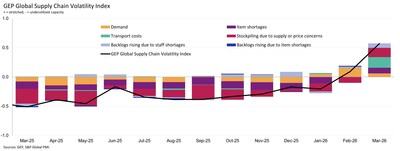
The GEP Global Supply Chain Volatility Index soared from 0.09 in February to 0.57 in March, its highest level since January 2023.
In March, global manufacturers increase safety stockpiling in response to maritime disruption, higher transportation costs and supplier price increases. Reports of inventory buffers being accumulated were the highest in three years, with increases across all major regions.
Uncertainty resulting from the conflict weighed on manufacturers' input demand, with factories around the world cutting purchasing volumes. Notably, item shortages hit a three-year high despite slowing demand, signaling the emergence of bottlenecks, with the availability of materials such as polymers, PVC and rubber, as well as energy-intensive metals such as aluminum and copper reportedly deteriorating the most.
Surging oil prices pushed global transportation costs to a four-year high in March. The impact was felt globally, but especially strongly in Asia, given its reliance on Middle East oil. Taiwan, Vietnam, South Korea and Japan reported surging producer price inflation during March.
"The war is pushing up costs, triggering stockpiling and creating shortages across supply chains, but it has not yet escalated into a broad-based shock that materially slows global economic growth," said Mukund Acharya, vice president, consulting, GEP. "Companies need to secure supply where it matters most while avoiding broad stockpiling that can lock in higher costs."
Interpreting the data:
Index > 0, supply chain capacity is being stretched. The further above 0, the more stretched supply chains are.
Index < 0, supply chain capacity is being underutilized. The further below 0, the more underutilized supply chains are.
Interpreting the data:
Index > 0, supply chain capacity is being stretched. The further above 0, the more stretched supply chains are.
Index < 0, supply chain capacity is being underutilized. The further below 0, the more underutilized supply chains are.
MARCH 2026 REGIONAL KEY FINDINGS
MARCH 2026 KEY FINDINGS
For more information, visit www.gep.com/volatility.
Note: Full historical data dating back to January 2005 is available for subscription. Please contact economics@spglobal.com.
The next release of the GEP Global Supply Chain Volatility Index will be 8 a.m. ET, May 12, 2026.
About the GEP Global Supply Chain Volatility Index
The GEP Global Supply Chain Volatility Index is produced by S&P Global and GEP. It is derived from S&P Global's PMI® surveys, sent to companies in over 40 countries, totaling around 27,000 companies. The headline figure is a weighted sum of six sub-indices derived from PMI data, PMI Comments Trackers and PMI Commodity Price & Supply Indicators compiled by S&P Global.
A Supply Chain Volatility Index is also published at a regional level for Europe, Asia, North America and the U.K. For more information about the methodology, click here.
Media Contacts
Derek Creevey | Joe Hayes | S&P Global Market Intelligence |
Director, Public Relations | Principal Economist | Corporate Communications |
GEP | S&P Global Market Intelligence | Email: Press.mi@spglobal.com |
Phone: +1 646-276-4579 | Phone: +44-1344-328-099 | |
Email: derek.creevey@gep.com | Email: joe.hayes@spglobal.com |
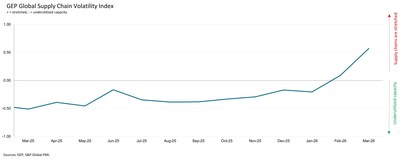
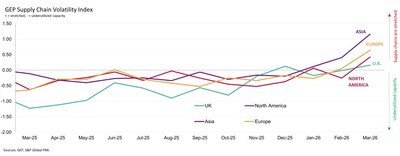

Photo - https://mma.prnewswire.com/media/2953258/GEP_SCVI_breakdown.jpg
Photo - https://mma.prnewswire.com/media/2953259/GEP_SCVI_headline.jpg
Photo - https://mma.prnewswire.com/media/2953260/SCVI_ALL.jpg
Logo - https://mma.prnewswire.com/media/518346/GEP_Logo.jpg
 View original content:https://www.prnewswire.co.uk/news-releases/middle-east-war-drives-global-supply-chain-pressures-to-a-three-year-high-gep-global-supply-chain-volatility-index-302738828.html

Die Aktie der Porsche AG hat sich am Dienstagmorgen trotz zurückhaltender Analystenkommentare freundlich gezeigt. Auf der Handelsplattform Tradegate notierte das Papier um 08:45 Uhr mit 42,35 Euro und damit 1,32 Prozent im Plus. Im Vorfeld der anstehenden Quartalszahlen haben mehrere Investmenthäuser ihre Einstufungen und Kursziele bestätigt – allerdings mit deutlich unterschiedlicher Tonlage.
Das Analysehaus Jefferies bleibt bei seiner neutralen Haltung und stuft die Vorzugsaktien der Porsche AG weiter mit "Hold" ein. Das Kursziel liegt unverändert bei 41 Euro. Die jüngste Analysten-Telefonkonferenz im Vorfeld der Zahlen habe "keine Überraschungen" geliefert, schrieb Analyst Philippe Houchois. Hinweise auf eine Änderung der grundsätzlichen Einschätzung oder auf neue, marktrelevante Informationen ergaben sich demnach nicht.
Deutlich vorsichtiger positioniert sich die britische Investmentbank Barclays. Sie bestätigt die Einstufung "Underweight" mit einem Kursziel von 40 Euro. Analyst Henning Cosman verweist in seinem Ausblick auf die bereits veröffentlichten Absatzzahlen. Vor diesem Hintergrund erwartet er, dass der Umsatz im ersten Quartal weniger stark zurückgehen dürfte als die Großhandelserlöse. Zugleich rechnet er jedoch damit, dass die Ebit- und Free-Cashflow-Margen jeweils am oberen Ende der für 2026 ausgegebenen Zielspannen liegen werden – ein Hinweis darauf, dass Profitabilität und Cash-Generierung aus Analystensicht intakt bleiben könnten, auch wenn das Volumen unter Druck steht.
Die unterschiedlichen Einschätzungen spiegeln die gemischte Erwartungshaltung des Marktes wider: Während Jefferies angesichts eines aus Analystensicht weitgehend erwartungsgemäßen Nachrichtenflusses auf eine abwartende Haltung setzt, beurteilt Barclays das Chance-Risiko-Verhältnis der Aktie zurückhaltender. Dass der Kurs sich dennoch oberhalb beider Kursziele hält und zuletzt zulegen konnte, deutet darauf hin, dass ein Teil der Investoren auf robuste Margen und eine mögliche positive Überraschung bei den anstehenden Zahlen setzt – auch wenn die professionellen Beobachter vorerst überwiegend auf Vorsicht und selektives Engagement pochen.