ELLAND, England, March 10, 2026 /PRNewswire/ -- A-SAFE, the global leader in workplace safety solutions, has completed a new installation at Leeds Bradford Airport's new terminal extension and baggage area, strengthening safety across key operational areas. The project builds on A-SAFE's aviation expertise, with its systems chosen by major international airports including London Heathrow, London Gatwick, New York JFK, Abu Dhabi, Hong Kong and Milan-Malpensa.
Statistics from the UK Civil Aviation Authority show passenger numbers reached more than 292 million in 2024, a 7% increase on the previous year. This growth is putting airports under pressure to maintain performance at higher volumes.
James Smith, Co-CEO of A-SAFE, said: "Airports are under growing pressure to move more passengers, more quickly, without compromising safety. Meeting that demand requires safety solutions that do more than protect assets and instead keep operations moving while cutting the risk of disruption. Leeds Bradford is the latest example across our aviation projects of how Atlas systems help airports operate at scale with confidence while keeping everyone and everything safe."
Gemma Whitehead, Head of Health, Safety, Environment & Compliance at Leeds Bradford Airport, said: "Safety is at the heart of everything we do at Leeds Bradford Airport, and this latest installation by A-SAFE is a testament to that commitment. Their expertise in aviation environments, combined with close collaboration with Farrans Construction and Millar Design & Management, has helped us enhance protection for our passengers, staff and assets in critical operational areas. We're proud to work with partners who share our high standards for safety and innovation."
The project was delivered in partnership with Farrans Construction, the main contractor, and Millar Design & Management, a consultancy with specialist airport experience. A-SAFE worked closely with both organisations to review plans, resolve technical challenges and optimise the safety design to fit in around Leeds Bradford's current safety requirements.
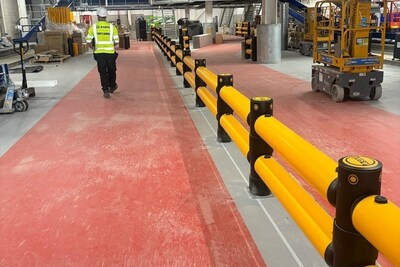
Leeds Bradford adopted A-SAFE's Atlas for infrastructure and baggage systems, Atlas Plus for passenger segregation, and high-impact bollards for baggage door protection. This is the same range A-SAFE has used in its other major airport projects, to meet the impact demands of environments where tugs pull multiple baggage trolleys at heavy combined loads. The installation was completed over three weeks, with two weeks in the baggage hall and one week on the apron.
Ray Barnett, Sales Director at A-SAFE UK, added: "Airports face safety demands that differ greatly from other sectors. Our experience on projects at major aviation hubs gave us the insight to support Leeds Bradford's development with systems that were fit for purpose for the requirements of their operations. It is positive to see safety recognised not just as protection, but as a foundation for keeping airport operations moving."
The completion of the Leeds Bradford project adds to A-SAFE's portfolio of UK airport work and highlights the role of safety infrastructure in keeping transport hubs reliable. With airports under pressure to handle rising passenger numbers and tighter schedules, A-SAFE's solutions are helping prepare operations for sustained growth and increased complexity.
Notes to Editors
About A-SAFE
A-SAFE is a global leader in workplace safety solutions. As the inventor of the world's first industrial-strength polymer safety barrier, A-SAFE has transformed workplace protection for warehouses, factories, airports and more. Operating across 65+ countries, A-SAFE's clients include Coca-Cola, Nestlé and Amazon. The company was a key contributor to the creation of PAS 13 – the BSI-backed global Code of Practice for safety barriers.
For further information, visit www.asafe.com.
Photo: https://mma.prnewswire.com/media/2929031/A_SAFE_pedestrian_barrier.jpg
Photo: https://mma.prnewswire.com/media/2929032/A_SAFE_barriers_solution.jpg
Logo: https://mma.prnewswire.com/media/2929030/A_SAFE_Logo.jpg

 View original content:https://www.prnewswire.co.uk/news-releases/leeds-bradford-airport-chooses-a-safe-for-new-terminal-and-baggage-safety-systems-302709244.html


Die europäischen Aktienmärkte haben zur Wochenmitte ihre kurze Erholungsphase beendet und sind erneut ins Minus gedreht. Auslöser ist nach Einschätzung von Marktbeobachtern vor allem die wachsende Unsicherheit im Nahen Osten, die über die Energiepreise zunehmend als Belastungsfaktor für die Weltwirtschaft wahrgenommen wird. "Die Situation im Nahen Osten führt über die Energiepreise zu massiven Beeinträchtigungen der Weltwirtschaft", sagte Andreas Lipkow, Marktanalyst beim Broker CMC Markets. Das größte Problem bleibe die Unsicherheit; mögliche Stützungsmaßnahmen wie die Freigabe strategischer Ölreserven verpufften deshalb rasch.
Der Eurozonen-Leitindex EuroStoxx 50 verlor im Verlauf rund ein halbes bis knapp ein Prozent und lag je nach Messzeitpunkt zwischen etwa 0,56 Prozent und 0,73 Prozent im Minus. Auch die Leitindizes außerhalb der Währungsunion gaben nach: Der britische FTSE 100 sank um rund 0,6 bis 0,8 Prozent, der Schweizer SMI um etwa 0,7 bis 0,8 Prozent. Die gleichgerichteten Rückgänge an den großen Handelsplätzen in Paris, London und Zürich spiegeln die zunehmende Risikoaversion der Anleger wider.
Gleichzeitig verlagerten Investoren ihr Kapital in vermeintliche Profiteure höherer Energiepreise. Ölwerte zählten europaweit zu den Stützen des Marktes. Die Notierungen für Rohöl drehten nach zwei schwächeren Handelstagen wieder nach oben, angetrieben von der Sorge, dass es zu längeren Unterbrechungen der Öllieferungen durch die strategisch wichtige Straße von Hormus im Persischen Golf kommen könnte. Damit scheint der Preisrückgang, der am Montag eingesetzt und sich am Dienstag fortgesetzt hatte, vorerst gestoppt. Dagegen litten besonders Branchen, deren Kostenstrukturen empfindlich auf steigende Energie- und Treibstoffpreise reagieren. Fluggesellschaften wurden von den deutlich höheren Kerosinpreisen belastet, und auch Logistiker sowie Chemieunternehmen gerieten unter Druck. Zinssensitive Immobilienwerte standen zusätzlich wegen fortbestehender Inflations- und Zinsängste auf den Verkaufslisten.
Relativ robust präsentierte sich der europäische Einzelhandelssektor. Unterstützt wurde er vom Schwergewicht Inditex, dessen Aktien zulegten und damit dem Marktsegment Stabilität verliehen. Der spanische Textilhändler hatte im Geschäftsjahr 2025/26 etwas besser verdient als erwartet; laut Analysten entwickelte sich zudem der Start in das laufende Jahr im Februar und Anfang März über den Prognosen. Beobachter verweisen darauf, dass die Bewertung der Aktie als attraktiv gilt und den Papieren in dem nervösen Marktumfeld eine gewisse Stütze bietet. In London dagegen gerieten die Anteilscheine des Versicherers und Vermögensverwalters Legal & General deutlich unter Druck und zählten mit einem Kursabschlag im hohen einstelligen Prozentbereich zu den größten Verlierern im FTSE 100.