PARMA, Italy and NEW YORK, April 30, 2026 /PRNewswire/ -- IBM (NYSE: IBM) and the Dallara Group, a world-leading racing and high-performance vehicle manufacturer, today announced a collaboration to advance vehicle design and optimization using AI and explore the use of quantum computing. The work combines Dallara's expertise in high-performance vehicle engineering with IBM's leadership in AI for physics and quantum computing to investigate how to accelerate aerodynamic design and open a path to even more advanced simulation workflows.
For more than 50 years, Dallara has designed and supplied high-performance vehicles for some of the world's top racing series, including IndyCar — where track speeds can average more than 230 mph (370 km/h) — as well as Formula 2, Formula 3, Super Formula, and Indy NXT, with additional work in top-tier series such as Formula E, WEC, and IMSA. This breadth of racing programs provides a unique ability to validate simulation results against real-world vehicle performance. Dallara also applies its engineering to high-performance road vehicles and aerospace. These and other distinctive, innovation-driven features of the company were key in IBM choosing to collaborate with Dallara.
As part of the project, IBM has been developing domain-specific foundation models in close coordination with Dallara. The models leverage not only Dallara's high-fidelity aerodynamic simulation data but also the company's deep technical expertise. In a future step, the teams aim to integrate validated measurements of real vehicles in wind tunnels and on the track, but the use of high-quality simulation data alone is already producing compelling early results.
Engineers rely heavily on computational fluid dynamics (CFD), to predict aerodynamic forces and optimize how vehicles perform across components such as body geometry, underfloor, wings, and wheels. These simulations are powerful but computationally expensive. Even relatively narrow analyses may take a couple of hours or more, while full race car development workflows may take weeks or months as engineers iterate through geometry changes, operating conditions, and performance tradeoffs.
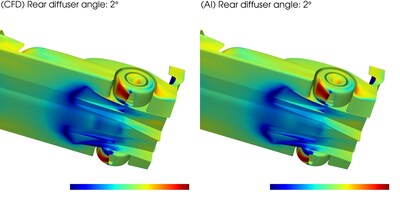
IBM and Dallara are using AI to speed up those workflows without replacing the underlying physics. In one early example, which focused on the geometry of a conceptual Le Mans Prototype 2 (LMP2)-like race car, the two companies jointly compared CFD analyses of multiple configurations of the rear diffuser — a part located in the rear underfloor that helps generate efficient downforce and thus grip — with results from the new physics-based AI method.
The traditional approach took a few hours to calculate all the configurations. Meanwhile, the AI model completed the same evaluations in about 10 seconds, identifying the same optimal design with roughly the same error margins as CFD. Applied to a typical complete set of hundreds of geometry configurations, such a speedup could cut days of simulation time down to minutes.
These and other preliminary results suggest Dallara engineers can evaluate more vehicle configurations in a fraction of time to move faster in early design phases, helping focus their most expensive computational resources on deep-dive optimization of race car design and development.
In parallel, IBM and Dallara are starting to explore how quantum and hybrid quantum-classical approaches could further enhance race car design workflows. By combining Dallara's expertise in high-fidelity vehicle engineering and CFD-driven design with IBM's leadership in quantum computing and AI, the collaboration will evaluate where these methods can complement traditional simulation workflows in the near-term while identifying longer-term opportunities for practical use in automotive and motorsport design.
"Racing has taught Dallara that there are two possible outcomes: you either win or are forced to learn. IBM's close collaboration on this innovative project is a testament of Dallara's willingness to continuously push its boundaries and never stop learning," said Andrea Pontremoli, Dallara CEO.
"Some of the hardest engineering challenges come down to accurately simulating the physical world," said Alessandro Curioni, IBM Fellow and VP, Algorithms and Applications, IBM Research. "With Dallara, IBM is applying AI to speed up aerodynamic design today while advancing quantum computing in parallel to push simulation farther. Together, these technologies can help engineers move faster, explore more possibilities, and ultimately design better-performing vehicles."
Advancing aerodynamic design with AI
Designing a high-performance vehicle means balancing downforce, drag, stability, and responsiveness across conditions that can change from race to race. Because some parts are designed with exacting precision, even small design changes can lead to surprisingly large impacts on performance, and the best aerodynamic solution is not always obvious.
The AI models are being designed to help predict aerodynamic behaviors directly from geometry and related engineering inputs. As the collaboration progresses, IBM and Dallara plan to expand the AI models across a wider range of conditions, such as different maneuvers or overtaking scenarios, apply them to design new vehicles and develop tools that enable faster exploration of new aerodynamic configurations, before investing in intensive full-vehicle simulations.
"High-performance vehicles are an ideal proving ground for neural surrogate models, but the potential impact goes well beyond the racetrack," said Fabrizio Arbucci, Dallara CIO. "More efficient designs could benefit all transport categories, from passenger vehicles to aircraft, and even other industries at the mercy of aerodynamics. Even a one to two percent reduction in drag across passenger vehicles could add up to meaningful fuel-efficiency gains at scale."
Initial results of the collaboration are detailed in a preprint study published at arXiv on April 20, 2026. This work builds upon a new AI model developed by IBM, called Gauge-Invariant Spectral Transformers (GIST), which was described in a March 17th preprint study. IBM and Dallara presented these and other advances in applying AI to complex physical systems on April 26, 2026, at the International Conference on Learning Representations in Rio de Janeiro.
About IBM
IBM is a leading provider of global hybrid cloud and AI, and consulting expertise. IBM helps clients in more than 175 countries capitalize on insights from their data, streamline business processes, reduce costs and gain the competitive edge in their industries. Thousands of governments and corporate entities in critical infrastructure areas such as financial services, telecommunications and healthcare rely on IBM's hybrid cloud platform and Red Hat OpenShift to affect their digital transformations quickly, efficiently and securely. IBM's breakthrough innovations in AI, quantum computing, industry-specific cloud solutions and consulting deliver open and flexible options to our clients. All of this is backed by IBM's long-standing commitment to trust, transparency, responsibility, inclusivity and service. Visit www.ibm.com for more information.
About The Dallara Group
Founded in 1972 by Giampaolo Dallara, Dallara is a world-leading manufacturer specializing in the design, engineering, and production of racing cars for top-tier motorsports. The firm has expanded globally from Italy's Motor Valley with a US Dallara Experience Hub in Speedway, Indiana. Dallara is the sole builder of racing cars for the IndyCar, Indy NXT, Formula 2, Formula 3 and Super Formula Championships, it also supplies Cadillac and BMW in both the WEC and IMSA championships. The expertise acquired in racing is regularly used both in the automotive world through consultancies and production services, with also Dallara branded products like the Dallara Stradale and DallaraEXP and more recently in aerospace. Visit www.dallara.it for more information.
Media Contacts
IBM Research
Dave Mosher
IBM Research Communications
dave.mosher@ibm.com
Ashley Peterson
IBM Research Communications
ashley.peterson@ibm.com
Dallara
Andrea Vecchi
Dallara Marketing & Communications Director
a.vecchi@dallara.it
Photo - https://mma.prnewswire.com/media/2969315/IBM_and_Dallara_CFD_vs_GIST_modeling.jpg
Logo - https://mma.prnewswire.com/media/2319830/IBM_LOGO_1.jpg
 View original content:https://www.prnewswire.co.uk/news-releases/ibm-and-dallara-to-advance-ai-and-quantum-powered-design-for-high-performance-vehicles-302758176.html

An den europäischen Aktienmärkten haben die Kurse am Dienstag weiter nachgegeben. Der EuroStoxx 50 setzte seine Verlustserie fort und schloss den siebten Handelstag in Folge im Minus. Der Leitindex für die Schwergewichte der Eurozone fiel um 0,41 Prozent auf 5.836,10 Punkte und damit auf den niedrigsten Stand seit fast drei Wochen. Marktteilnehmer verwiesen auf die anhaltende Unsicherheit rund um den Konflikt im Nahen Osten, der sich in der Region Iran zuspitzt, sowie auf deutlich gestiegene Energiepreise und wachsende Inflationssorgen.
Die Belastungsfaktoren schlagen zunehmend auch in den Erwartungen der Verbraucher durch. Nach einer aktuellen Umfrage der Europäischen Zentralbank rechnen die Haushalte in der Eurozone auf Sicht von zwölf Monaten mit einer Teuerungsrate von 4,0 Prozent. Zuvor hatten die Befragten nur mit 2,5 Prozent Inflation gerechnet. Der Sprung nach oben nährt Spekulationen, dass der Preisauftrieb hartnäckiger bleiben könnte als erhofft – ein Szenario, das den Spielraum der Notenbank für schnelle und deutliche Zinssenkungen begrenzen würde und damit Bewertungsdruck auf Aktien ausübt.
Im Branchenvergleich zeigten sich erneut Öl- und Energiewerte robust. Der über die vergangenen Tage deutlich gestiegene Ölpreis stützte die Unternehmen des Sektors, zusätzlich profitierten die Titel des britischen Energiekonzerns BP von besser als erwarteten Quartalszahlen. Dem Unternehmen hatten die höheren Notierungen am Ölmarkt zum Jahresauftakt überraschend kräftige Gewinne beschert, was die Aktie um rund ein Prozent nach oben trieb. Anleger suchten damit ausgerechnet in jenen Titeln Zuflucht, die direkt von der angespannten Lage am Energiemarkt profitieren.
Unter Druck standen dagegen erneut die Pharmawerte. Papiere des Schweizer Konzerns Novartis fielen zeitweise um mehr als fünf Prozent, bevor sie im späten Handel wieder ins Plus drehten. Belastet wurde die Stimmung durch einen unerwartet schwachen Jahresstart im wichtigen US-Markt, wo zunehmender Wettbewerb durch Nachahmermedikamente auf die Erlöse drückt. Aktien von Bayer gerieten ebenfalls unter die Räder und verloren 4,6 Prozent, nachdem Investoren auf neue Entwicklungen rund um eine Anhörung reagiert hatten. Insgesamt überwogen in der Branche die Sorgen über Gewinnrisiken und Preisdruck.
Außerhalb der Eurozone zeigte sich ein gemischtes Bild. In London behauptete sich der FTSE 100 mit einem leichten Plus von 0,11 Prozent bei 10.332,79 Punkten, gestützt auch von den dort stark gewichteten Rohstoff- und Energiewerten. In der Schweiz schloss der SMI 0,13 Prozent tiefer bei 13.147,94 Zählern. Analysten sehen die europäischen Märkte vorerst in einer von geopolitischen Risiken und Inflationsdaten bestimmten Spanne gefangen, während Anleger auf klarere Signale zur weiteren Geldpolitik der EZB und zur Entwicklung der Energiepreise warten.