New kit offers researchers and development teams a meaningful advance in expression speed and output
BOSTON, May 12, 2026 /PRNewswire/ -- GenScript Biotech Corporation announced the launch of TurboCHO™ Protein Expression Kit, a next-generation antibody expression reagent designed to set a new benchmark for speed, performance, output and ease-of-use. One of the company's largest global product launches to date, this kit targets the fast-growing expression reagent market, driven by high-throughput and AI-enabled research.
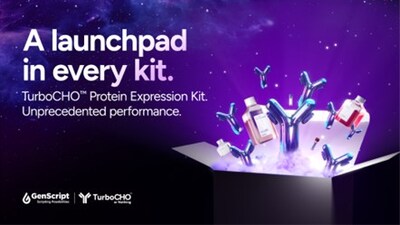
Producing research-grade antibodies and proteins is a foundational step in drug discovery and biologics development. The new kit brings GenScript's proven protein-expression technology directly to the bench in a ready-to-use format, enabling labs of any size to generate high‑quality protein in as little as five business days. As a result, researchers can access reliable data sooner and make earlier, more confident decisions.
"TurboCHO™ Protein Expression Kit delivers outstanding performance and unmatched value, putting powerful innovation within reach of every lab working to advance science," said GenScript's Rotating CEO Sherry Shao. "By providing a launchpad to market, this kit helps bring new medicines to patients' faster, when time matters most."
The product debuted yesterday at the opening of the PEGS Summit in Boston, but attendees will have opportunities throughout the week to learn more and engage with the GenScript team. The Protein Expression Kit is available in two configurations:
Early Feedback Supports Real-World Impact
Early adopters in the beta program have reported performance that is "best in class" for speed and value, demonstrating its real-world impact.
_________________________________________________________________________________
Performance Snapshot: How the Kit Compares
_________________________________________________________________________________
For drug developers and research teams managing increasingly compressed discovery timelines, this performance translates into faster candidate selection, reduced time-to-data, and the capacity to validate more candidates as they move into experimental testing.
The launch represents the first phase of a broader innovation roadmap designed to drive continued industry leadership, with planned advances spanning next‑generation CHO cell line enhancements, improved transfection systems, and scalable, automation‑ready formats.
"By delivering higher-quality antibody expression with dramatically faster time-to-data, we are eliminating a critical bottleneck in drug discovery," said Ray Chen, President of GenScript Life Science Group. "Designed for today's complex molecules, this kit ensures reproducibility and seamless screen-to-scale translation, while enabling more designs to be tested at lower cost. For research teams working under aggressive discovery timelines, the real question isn't whether to adopt this solution. It's how quickly they choose to leverage it to redefine what's possible."
TurboCHO™ Protein Expression Kit is available immediately through GenScript's direct sales channels and authorized distributors. To support early adoption, GenScript is offering introductory pricing for a limited time, along with technical support for onboarding and workflow optimization. Inventory is in place to support both domestic and international demand. For more information or pricing, visit the GenScript website.
About GenScript
Founded in 2002 in New Jersey, GenScript Biotech Corporation accelerates innovation in biotech and healthcare by providing researchers and companies with the building blocks needed to develop groundbreaking treatments and products. As a cornerstone of the global life science ecosystem, GenScript actively collaborates with a diverse network of partners—from academic institutions to industry leaders—to co-create cutting-edge solutions that redefine service excellence. Guided by its mission to Make People and Nature Healthier Through Biotechnology, GenScript has become a trusted global partner with a team of 6,100+ employees, supporting over 200,000 customers across 100+ countries and regions, including the world's Top 20 pharma companies. For more information: www.genscript.com
Media Contacts:
Kate Grusich
Senior Corporate Communications Manager
Katherina.Grusich@genscript.com


Photo - https://mma.prnewswire.com/media/2977421/Picture1_launchpad.jpg
Photo - https://mma.prnewswire.com/media/2978147/PEGS_Summit.jpg
Logo - https://mma.prnewswire.com/media/2855189/GenScript_Logo.jpg
 View original content:https://www.prnewswire.co.uk/news-releases/genscript-launches-turbocho-protein-expression-kit-delivering-the-fastest-path-to-antibodies-in-its-class-302769842.html

Die Einigung zwischen den USA und dem Iran auf ein Rahmenabkommen zur Beendigung des Iran-Kriegs sorgt in der Handelsschifffahrt für vorsichtige Erleichterung. Besonders im Fokus steht die Straße von Hormus, eine der wichtigsten Seepassagen für den weltweiten Öl- und Flüssiggas-Handel. Seit Beginn des Konflikts Ende Februar ist die Meerenge weitgehend blockiert, zahlreiche Handelsschiffe sitzen im Persischen Golf fest. Nun soll die Passage nach der geplanten Unterzeichnung des Abkommens wieder geöffnet werden.
US-Präsident Donald Trump kündigte an, dass die Straße von Hormus nach dem Abschluss der Vereinbarung wieder für den Verkehr freigegeben werden solle. Die Unterzeichnung ist für Freitag in Genf vorgesehen. Für die deutsche Handelsschifffahrt wäre dies ein entscheidender Schritt zur Normalisierung. „Die Signale aus den Gesprächen zwischen den USA und dem Iran machen auch der Schifffahrt Hoffnung“, sagte Martin Kröger, Hauptgeschäftsführer des Verbands Deutscher Reeder (VDR). Zugleich mahnte er, es müsse sich erst zeigen, ob die Passage dauerhaft sicher befahrbar sein werde. Man sei „vorsichtig optimistisch“.
Die Branche hat allen Grund, auf rasche Entspannung zu hoffen. Nach Angaben des VDR sitzen aktuell noch 46 Schiffe deutscher Reedereien mit rund 1.000 Seeleuten im Persischen Golf fest. Die Blockade der Meerenge trifft nicht nur die Reedereien, sondern bremst den globalen Energiehandel. Die UN-Sonderorganisation für Seeschifffahrt (IMO) begrüßte die Einigung ausdrücklich. Seit Ausbruch des Konflikts wurden der IMO zufolge 46 Angriffe auf Handelsschiffe in der Region bestätigt, bei denen 14 Seeleute ums Leben kamen.
Trotz der diplomatischen Fortschritte sehen Branchenverbände die Lage in der Region weiter kritisch. Der internationale Schifffahrtsverband Bimco bewertet die Sicherheitslage in der Straße von Hormus auch nach Bekanntwerden des Rahmenabkommens als instabil. Eine Durchfahrt bleibe sehr riskant, heißt es aus dem Verband. Für Reeder und Charterer stellt sich damit die Frage, wie schnell und in welchem Umfang sie ihre Routen wieder über die Meerenge führen können – oder ob Ausweichrouten zumindest mittelfristig bestehen bleiben müssen.
Für den Moment überwiegt in der Schifffahrt die Hoffnung, dass die geplante Vereinbarung in Genf die Voraussetzungen für eine nachhaltige Entspannung an einem der neuralgischsten Punkte des globalen Seehandels schafft. Ob und wie schnell sich die Zahl der festliegenden Schiffe reduziert und sich die Risikoeinschätzungen der Versicherer und Verbände anpassen, dürfte entscheidend dafür sein, wann sich der Verkehr durch die Straße von Hormus wieder weitgehend normalisiert.