1,000th T150 turbojet engine produced in 2026 at Destinus' Hengelo facility, marking a propulsion milestone for scalable cruise missile manufacturing.
AMSTERDAM, June 18, 2026 /PRNewswire/ -- Destinus has reached a significant production milestone, completing its 1,000th T150 turbojet engine in 2026. Developed and manufactured in-house in Europe, the T150 powers the Ruta B1 and Ruta B2 cruise missile family, supporting serial production and operational deployment. The milestone strengthens Europe's ability to produce cruise-class propulsion at an industrial scale.
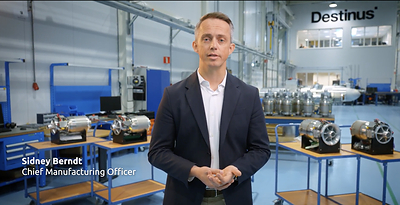
Propulsion remains a critical bottleneck in scalable cruise missile production. The T150 program directly addresses this constraint with a turbojet engine developed from scratch by Destinus and manufactured on a European production line built for repeatable, qualification-driven output. The engine supports current Ruta output and provides a scalable propulsion base for continued production ramp-up.
"Producing one engine is engineering. Producing a thousand is industrial capability," said Sidney Berndt, Destinus' Chief Manufacturing Officer. "The T150 was built from scratch. The design, tooling, test infrastructure, supply chain and quality control were all developed and are owned by Destinus. What you see here is not a prototype line. It is a European production system that can sustain the production of thousands of missile systems per year."
Destinus' vertically integrated approach to propulsion is central to its industrial model. By controlling engine design and manufacturing in-house, Destinus reduces dependency on external propulsion suppliers, which has historically limited European cruise missile production rates. The T150 production line is designed for continuous ramp-up, supporting both current Ruta output and planned capacity expansion, including through the Rheinmetall Destinus Strike Systems joint venture.
The production of the 1,000th engine follows Destinus' recent announcement of Ruta B3, a long-range strike system with a range of 2,000 km, powered by the next-generation T220 turbojet engine, also being developed in-house. The T150 and T220 together form a propulsion family designed to power key parts of Destinus' cruise missile portfolio.
A video marking this milestone featuring Destinus Chief Manufacturing Officer Sidney Bernt at the production facility is available at [link].
About Destinus
Destinus builds Europe's capacity to strike, defend, and replenish at scale. We design and manufacture cruise missiles, guided rockets, ballistic systems, and interceptors in Europe for European and allied armed forces. Behind these systems sits a vertically integrated base of propulsion, warheads, autonomy, and critical manufacturing. Destinus turns European engineering into sovereign military capability. Produced across Europe. Owned in Europe. Made for Europe.
Media contact
FTI Consulting: destinus@fticonsulting.com

 View original content to download multimedia:https://www.prnewswire.co.uk/news-releases/engine-no-1000-destinus-reaches-industrial-scale-turbojet-production-in-europe-302803526.html

Bystronic hat seine Erwartungen für das laufende Geschäftsjahr 2026 nach unten angepasst. Der Hersteller von Maschinen für die Blechbearbeitung rechnet zwar weiterhin mit einem höheren Nettoumsatz als im Vorjahr, erwartet jedoch keine Verbesserung der Profitabilität mehr. Bereits im zweiten Quartal 2026 dürften Auftragseingang, Nettoumsatz und Ergebnis unter den bisherigen Annahmen liegen, obwohl sie gegenüber dem ersten Quartal zulegen sollen.
Das Management verweist auf anhaltend schwierige Marktbedingungen im Kerngeschäft. Während die Nachfrage nach Biegelösungen stabil bleibt, leidet das Lasergeschäft weiter unter einer schwachen Marktlage. Geringere Kapazitätsauslastung und Preisdruck im Verkauf von Einzelmaschinen wirken zusätzlich auf die Marge. Hinzu kommt, dass der Trend zu stärker automatisierten Lösungen zwar den Auftragsbestand stützt, die Projekte jedoch längere Laufzeiten haben und sich der hohe Auftragsbestand dadurch langsamer in Nettoumsätze umwandelt.
Einen Lichtblick liefert die neu geschaffene Geschäftseinheit Bystronic Rofin. Sie trägt nach Unternehmensangaben weiterhin positiv zum Konzernergebnis bei, gestützt von einer robusten Nachfrage nach Anwendungen im Halbleiterbereich. Dieser Bereich soll auch dazu beitragen, dass der Konzernumsatz 2026 insgesamt über dem Niveau des Vorjahres liegt, auch wenn die Ergebnisqualität im Vergleich zu 2025 zurückbleiben dürfte.
Konkrete Zahlen zu Auftragseingang, Umsatz und Ergebnis nannte Bystronic bislang nicht. Ausführlichere Informationen zur Geschäftsentwicklung und zum weiteren Ausblick will das Unternehmen mit dem Halbjahresbericht vorlegen, der am 23. Juli veröffentlicht werden soll. Dann dürfte sich zeigen, in welchem Ausmass der Druck im Lasergeschäft und die Verzögerungen bei Automationsprojekten auf die Jahresziele durchschlagen – und wie stark Bystronic Rofin diese Effekte im laufenden Jahr abfedern kann.