Next-generation spray dried plasma demonstrates safety profile comparable to standard frozen plasma, advancing the future of decentralized transfusion medicine
BOSTON, June 18, 2026 /PRNewswire/ -- Velico today announced the publication of its Phase 1 first-in-human clinical trial evaluating Frontline On Demand Plasma (ODP), a next-generation spray-dried plasma product designed to transform access to lifesaving plasma transfusion in emergency, military, prehospital and austere care environments.
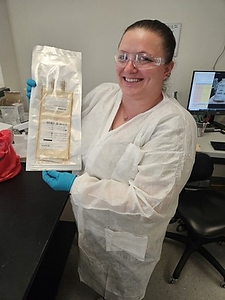
The multicenter, randomized, dose-escalation study, published in the journal Transfusion, demonstrated that Velico's spray-dried plasma was well tolerated across all dose levels and exhibited a safety profile comparable to standard frozen plasma (PF24).
The publication, titled "Next generation spray-dried on-demand plasma: A multicenter, randomized, dose-escalation, first-in-human safety study," marks a major milestone in the evolution of decentralized plasma capabilities.
"This study represents a defining moment not only for Velico, but for the future of trauma care and transfusion medicine," said Richard Meehan. "For decades, the logistical limitations of plasma have prevented widespread access in frontline and resource-constrained settings. FrontlineODP™ has the potential to fundamentally change that paradigm by enabling rapid, portable and operationally resilient plasma availability wherever patients need it most."
Advancing the Future of Plasma Access
Plasma transfusion has been shown to improve survival outcomes in patients at risk of hemorrhagic shock, particularly when administered early. However, traditional frozen plasma products require cold-chain storage, thawing infrastructure and complex logistics - barriers that significantly limit availability in remote, prehospital, military and disaster-response settings.
Velico's FrontlineODP™ addresses these challenges through proprietary spray-drying technology that enables:
The Phase 1 study enrolled 24 healthy volunteers across three sequential dose-escalation cohorts. Participants received escalating doses of FrontlineODP™ up to 800mL, including a randomized, double-blind crossover comparison against standard frozen plasma.
Key findings from the study include:
"These results validate the promise of spray-dried plasma as a next-generation transfusion platform," said Jose A. Cancelas. "The ability to safely deliver plasma without traditional cold-chain constraints has profound implications for trauma systems, military medicine and emergency preparedness globally."
Supporting Military and Civilian Readiness
Velico's decentralized plasma technology is being actively evaluated for applications across military medicine, disaster response, civilian trauma systems and national resilience programs worldwide.
The company's FrontlineODP™ and veliPod™ decentralized production platforms are designed to support sovereign blood resilience strategies by enabling localized plasma manufacturing and rapid deployment capabilities.
"With growing global demand for resilient medical infrastructure, these findings reinforce the importance of deployable, decentralized blood solutions," added Meehan. "Velico remains committed to advancing technologies that improve survivability and operational readiness in the world's most challenging environments."
The full study is available online in Transfusion:
https://doi.org/10.1111/trf.70262
CAUTION:
The FrontlineODP™ Spray Dried Plasma System has not received FDA or EU approval for any indication. Regulatory requirements of individual countries and regions will determine approval, clearance, or market availability.
This project has been funded in whole or in part with federal funds from the Department of Health and Human Services; Administration for Strategic Preparedness and Response; Biomedical Advanced Research and Development Authority, under Contract No. 75A50121C00059
About Velico
Velico is a private US medical technology company, committed to the mission of eliminating preventable death from bleeding. Headquartered in Beverly, Massachusetts, USA. Velico personnel have substantial expertise and experience in transfusion medicine and medical device development. In support of its mission, Velico is developing partnerships with civilian, government and military blood center leadership, trauma surgeons, emergency medical physicians, military medics and first responders worldwide.
For more information visit www.veli.co

 View original content to download multimedia:https://www.prnewswire.co.uk/news-releases/designed-for-the-frontline-validated-in-humans-velico-announces-successful-clinical-trial-302803340.html

Die Schweizer Stimmberechtigten haben einer Verschärfung des Zivildienstgesetzes zugestimmt. Laut definitiven Ergebnissen votierten 52,5 Prozent für die Reform, rund 47,5 Prozent dagegen. Damit setzte sich der Kurs von Bundesrat und Parlament durch, den Zivildienst wieder klar als Ausnahme und nicht als gleichwertige Alternative zum obligatorischen Militärdienst zu definieren. Die Stimmbeteiligung lag mit rund 58 Prozent vergleichsweise hoch; 1'690'343 Personen legten ein Ja in die Urne, 1'531'878 stimmten Nein.
Das Ergebnis offenbart deutliche regionale Bruchlinien. Während viele deutschsprachige Kantone die Reform klar unterstützten – etwa Aargau mit 56,2 Prozent, St. Gallen mit 58,9 Prozent, Graubünden mit 59,3 Prozent und Luzern mit 56,9 Prozent Ja – fiel das Verdikt in der Romandie gespalten aus. Genf, Waadt, Neuenburg und Jura lehnten die Vorlage ab, mit Nein-Anteilen von bis zu gut 60 Prozent im Jura. Basel-Stadt stellte sich ebenfalls gegen die Verschärfung, und der Kanton Zürich kippte nach Auszählung der städtischen Stimmen knapp ins Nein-Lager. Demgegenüber sagten Wallis (57,1 Prozent), Freiburg (50,2 Prozent) und das Tessin (53,9 Prozent) Ja zur Reform.
Kern der Vorlage ist ein Paket von sechs Massnahmen, die den Wechsel aus der Armee in den Zivildienst deutlich unattraktiver machen sollen. Künftig müssen alle, die in den Zivildienst wechseln, mindestens 150 Diensttage leisten – unabhängig davon, wie viele Tage im Militär noch offen wären. Für Unteroffiziere und Offiziere gilt damit neu derselbe Umrechnungsfaktor von 1,5 Zivildiensttagen pro verbleibendem Militärdiensttag wie für einfache Soldaten. Wer alle Armee-Ausbildungstage bereits absolviert hat, kann künftig nicht mehr in den Zivildienst wechseln, um der Schiesspflicht zu entgehen.
Zusätzlich werden der zeitliche Rahmen und die Einsatzmöglichkeiten enger gezogen. Zivildienstleistende müssen ab dem Jahr nach ihrem ersten Einsatz jährlich Dienst leisten, bis alle vorgeschriebenen Tage erfüllt sind. Wer vor oder während der Rekrutenschule ein Gesuch stellt, muss den langen Anfangseinsatz von 180 Tagen bereits im Jahr nach der Zulassung absolvieren. Einsätze, die ein begonnenes Medizinstudium voraussetzen, werden gestrichen – offiziell, weil der Armee medizinisches Personal fehlt. Bürgerliche Parteien werteten das Ja als Bestätigung, dass der Zivildienst eine Ausnahme bleiben solle; die links-grüne Nein-Allianz verweist angesichts des knappen Resultats auf die breite gesellschaftliche Unterstützung für den Zivildienst und kündigt an, weitere Verschärfungen bekämpfen zu wollen.