Collaboration targets DX-M2-based robotic AI infrastructure, expanding into VLA and VLM technologies for next-generation intelligent robots
SEOUL, South Korea, April 21, 2026 /PRNewswire/ -- DEEPX (CEO Lokwon Kim), a pioneer in ultra-low-power AI semiconductor technology, and Hyundai Motor Group's Robotics LAB have announced a strategic collaboration to jointly develop a next-generation Physical AI computing platform for advanced robotics.
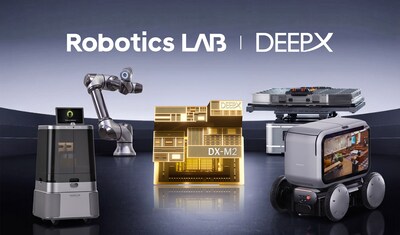
The partnership aims to co-develop an AI computing architecture capable of running large-scale generative AI models in real time within robotic systems. This goes beyond a simple technology exchange — it is a strategic effort to jointly architect core computing infrastructure for next-generation robot platforms.
The robotics AI field is increasingly centered on Vision-Language-Action (VLA) and Vision-Language Model (VLM) technologies — enabling robots to perceive surroundings via cameras, understand natural language commands, and make autonomous decisions. These capabilities are essential to transforming robots from simple automated machines into intelligent systems that can see, understand, and act.
To enable stable deployment of these capabilities, the two companies will collaborate across four key areas: ultra-low-power AI semiconductor architecture, AI computing hardware systems for robotics, Physical AI software stack, and robotics application AI libraries.
At the heart of this collaboration is DEEPX's next-generation chip, the DX-M2 — a Physical GenAI semiconductor designed to run large-scale AI models in ultra-low-power environments, enabling on-device AI inference in robotics, autonomous mobile systems, and industrial automation.
The Physical AI semiconductor market is projected to reach approximately $123 billion by 2030, with robotics and humanoids as primary demand drivers. DEEPX and Hyundai Motor Group Robotics LAB have been jointly developing low-power 'edge brain' technology for robotics over the past three years.
"The AI industry is rapidly shifting from data center-centric models to a Physical AI era. Ultra-low-power computing capable of running AI in real-world systems will become the core infrastructure. DEEPX aims to become the global leader in Physical AI computing platforms powering AI across robotics and industrial systems."
— Lokwon Kim, CEO, DEEPX
"In the era of Physical AI, robots are becoming the closest point of contact between AI technology and people. At Hyundai Motor Group Robotics LAB, our goal is to create robots that can naturally coexist with humans — and to achieve this, we are strategically building a core technology ecosystem in collaboration with specialized partners worldwide."
— Dong Jin Hyun, Vice President, Head of Robotics LAB, Hyundai Motor Group
Photo - https://mma.prnewswire.com/media/2961160/image.jpg
Logo - https://mma.prnewswire.com/media/2857355/5927209/DEEPX_Logo.jpg
 View original content:https://www.prnewswire.co.uk/news-releases/deepx-and-hyundai-motor-group-robotics-lab-partner-to-develop-next-generation-physical-ai-compute-platform-for-robotics-302747869.html

Die Luzerner Kantonalbank AG (LUKB) ist mit einem Ergebnis über den eigenen Erwartungen in das Jahr 2026 gestartet. Der Konzerngewinn legte im ersten Quartal um 4,5 Prozent auf 80,1 Millionen Franken zu, wie das Staatsinstitut am Freitag mitteilte. Der Geschäftserfolg als Mass der operativen Leistung stieg um 3,5 Prozent auf 90,0 Millionen Franken. Damit bestätigt die Bank ihren Ausblick für das Gesamtjahr, obwohl sie ein eingetrübtes Umfeld und Unsicherheiten im Zusammenhang mit dem Krieg im Iran konstatiert.
Der Geschäftsertrag erhöhte sich insgesamt um 5,0 Prozent auf 182,6 Millionen Franken. Treiber war vor allem das Zinsengeschäft, das um 4,1 Prozent auf 118,4 Millionen Franken zulegte. Nach Angaben der Bank trug ein aktives Zinsmanagement zu diesem Ergebnis bei, obwohl das Quartal von sinkenden Zinsen geprägt war. Das zinsunabhängige Geschäft wuchs insgesamt um 6,7 Prozent; insbesondere das Kommissions- und Dienstleistungsgeschäft profitierte von höheren Erträgen im Wertschriften- und Anlagebereich und legte um 10,7 Prozent auf 38,6 Millionen Franken zu.
Im Handelsgeschäft verzeichnete die LUKB dagegen einen leichten Rückgang: Der Erfolg sank um 4,9 Prozent auf 23,5 Millionen Franken, blieb nach Unternehmensangaben aber weiterhin über dem geplanten Wert. Auf der Kostenseite stieg der Aufwand um 5,8 Prozent auf 83,9 Millionen Franken, getrieben vor allem von höheren Personal- und Sachkosten. Dennoch verbesserte sich das Kosten-Ertrags-Verhältnis (Cost-Income-Ratio) leicht auf 45,3 Prozent nach 46,1 Prozent im Geschäftsjahr 2025 und liegt damit klar unter der eigenen Zielmarke von maximal 50 Prozent.
Beim Kreditvolumen verfolgt die Bank weiterhin einen gezügelten Wachstumskurs. Die Kundenausleihungen nahmen in der Berichtsperiode um 0,9 Prozent auf 46,8 Milliarden Franken zu, was laut Mitteilung „weiterhin Spielraum für Wachstum“ lässt. Auf Jahressicht strebt die LUKB ein Plus von 3,5 bis 5,5 Prozent bei den Ausleihungen an. In der Vermögensverwaltung kommt die Bank mit dem Ausbau ihrer Mandate zügig voran und visiert für das Gesamtjahr ein Wachstum von mindestens 1,2 Milliarden Franken an; in diesem Bereich sieht sich das Institut nach eigenen Angaben der strategischen Planung sogar etwas voraus.
Insgesamt liegt das Ergebnis des ersten Quartals 2026 nach Darstellung der LUKB über der eigenen Prognose. Dank Ertragsdiversifikation, Kostendisziplin und professionellem Bilanzmanagement fühlt sich die Bank in der Lage, trotz der Unsicherheiten rund um den Krieg im Iran am Mindestziel für den Konzerngewinn 2026 von 295 Millionen Franken festzuhalten. Diese Zielsetzung steht allerdings unter dem Vorbehalt, dass die Auswirkungen des Konflikts zeitlich und räumlich begrenzt bleiben.