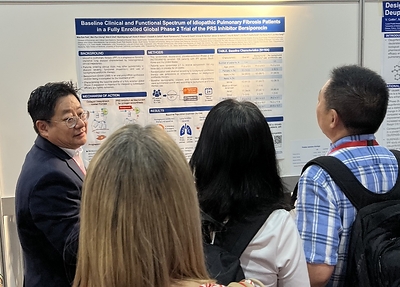
BARCELONA, Spain and SEOUL, South Korea, Sept. 24, 2026 /PRNewswire/ -- Daewoong Pharmaceutical (Co-CEOs Seongsoo Park and Changjae Lee) announced that it presented a poster on the baseline characteristics of all 104 patients enrolled in the global Phase 2 clinical trial of its idiopathic pulmonary fibrosis (IPF) drug candidate 'Bersiporocin (DWN12088)' at the European Respiratory Society (ERS) Congress 2026, held on September 6 (local time) in Barcelona, Spain.
Idiopathic Pulmonary Fibrosis is a disease in which various inflammatory and fibrotic signals interact, leading to excessive production and accumulation of collagen. Bersiporocin, being developed by Daewoong Pharmaceutical, selectively inhibits prolyl-tRNA synthetase (PRS), thereby reducing excessive collagen production associated with fibrosis.
Bersiporocin has a differentiated mechanism of action that targets collagen synthesis downstream of multiple profibrotic signals through PRS inhibition. Based on this distinct mechanism, it is being evaluated both in patients receiving background antifibrotic therapy and in those not receiving such treatment.
This presentation analyzed the baseline clinical and functional characteristics of all IPF patients recruited in South Korea and the United States. Following the presentation of interim enrollment data at KATRDIC 2025, Daewoong Pharmaceutical presented baseline data from the fully enrolled study population for the first time at ERS 2026.
The analysis showed that of the total 104 patients, 55 (52.9%) were from South Korea and 49 (47.1%) from the US. A total of 71 patients (68.3%) were receiving background antifibrotic therapy, while 33 patients (31.7%) were not. Mean forced vital capacity (FVC) was approximately 77% predicted, while mean diffusing capacity of the lungs for carbon monoxide (DLCO) was approximately 51% predicted. Overall, baseline clinical and functional characteristics were generally similar between patients with and without background antifibrotic therapy.
The ongoing global Phase 2 study is a randomized, double-blind, placebo-controlled trial taking place in South Korea and the US. Patients receive either Bersiporocin or a placebo twice daily for 24 weeks, with concomitant use of pirfenidone or nintedanib permitted. The study design reflects real-world IPF treatment settings by including patients both with and without background antifibrotic therapy.
This baseline analysis provides important context for interpreting the Phase 2 efficacy and safety results. Daewoong Pharmaceutical plans to announce top-line Phase 2 results in the first half of 2027.
Meanwhile, Bersiporocin has received Orphan Drug Designation and Fast Track status from the US FDA, as well as Orphan Drug Designation from the European Medicines Agency (EMA), driving its global development forward.
Professor Moo Suk Park of the Department of Pulmonology at Severance Hospital, who participated in the study, said, "This study provides a comprehensive overview of the baseline characteristics of 104 IPF patients enrolled in South Korea and the US. As the study includes patients both with and without background antifibrotic therapy, these baseline data will provide important context for interpreting the efficacy and safety outcomes of Bersiporocin."
Seongsoo Park, CEO of Daewoong Pharmaceutical, stated, "Successfully completing enrollment for the global Phase 2 trial and sharing the full baseline patient profile at ERS 2026 marks a significant milestone in Bersiporocin's development. We will continue to advance the program toward top-line Phase 2 results in H1 2027 and use these findings to inform subsequent global development."
[Reference]
https://drive.google.com/file/d/1XSXImvc5mcgdoSozP_B4BnDlsTW7Pfz_/view
Link to the poster: 'Baseline Clinical and Functional Spectrum of Idiopathic Pulmonary Fibrosis Patients in a Fully Enrolled Global Phase 2 Trial of the PRS Inhibitor Bersiporocin'

 View original content to download multimedia:https://www.prnewswire.co.uk/news-releases/daewoong-pharmaceutical-presents-baseline-characteristics-of-104-patients-in-global-phase-2-trial-for-ipf-drug-candidate-bersiporocin-at-ers-2026-302886913.html

Sandro Brotz kehrt dem Schweizer Radio und Fernsehen den Rücken und wechselt Anfang 2027 zur Boulevardzeitung «Blick». Der 56-jährige Journalist, derzeit Moderator und stellvertretender Leiter der Polit-Talksendung «Arena», wird SRF Ende Januar 2027 verlassen. Bis voraussichtlich Mitte Januar führt er weiterhin durch die «Arena». Beim zum Ringier-Konzern gehörenden «Blick» soll Brotz einen neuen Video-Podcast aufbauen und moderieren, der mehrmals pro Woche Themen aus Politik, Wirtschaft und Gesellschaft aufgreift.
Der Schritt markiert das Ende einer knapp 15-jährigen SRF-Ära für Brotz. Seit seinem Wechsel nach Leutschenbach im Juni 2012 prägte er zunächst als Moderator der investigativen Sendung «Rundschau» das Programm, später zusätzlich als Gastgeber des «Rundschau Talk». 2019 übernahm er schliesslich die «Arena» von Jonas Projer. Als Grund für den Wechsel nennt Brotz die Möglichkeit, bei «Blick» ein neues Format mitzuentwickeln und damit über die Rolle des klassischen Moderators hinauszugehen. Ganz neu ist das Ringier-Umfeld für ihn nicht: Vor seiner SRF-Zeit war er bereits unter anderem stellvertretender Chefredaktor des «SonntagsBlick».
Der Abgang von Brotz wirft bei SRF unmittelbar die Nachfolgefrage auf. Als Topfavorit galt zuletzt sein Kollege Mario Grossniklaus, der seit 2024 einmal im Monat die «Arena» moderiert und damit Brotz entlastet. Der 49-Jährige hat dieser Spekulation nun jedoch eine klare Absage erteilt. Auf Linkedin schrieb Grossniklaus, er werde sich nicht auf die Nachfolge seines «geschätzten Kollegen» bewerben. Stattdessen wolle er sich auf seine Aufgaben in der Wahlleitung von SRG und SRF konzentrieren – eine Funktion, die er als «grösste und spannendste Aufgabe» seiner bisherigen Karriere bezeichnet.
Mit der Absage von Grossniklaus bleibt offen, wer Brotz ab etwa Mitte Januar beerben wird. SRF verweist darauf, man wolle sich vorerst auf eine geordnete Übergabe der «Arena» konzentrieren. Der Wechsel von Brotz reiht sich ein in eine Serie prominenter Abgänge von SRF in Richtung Dufourstrasse: Bereits zuvor hatten unter anderem Reto Scherrer, Steffi Buchli, Christine Maier, Hannes Britschgi und der frühere «Arena»-Moderator Jonas Projer den Schritt zum Ringier-Konzern gewagt. Die Motive reichen von besseren Angeboten bis hin zum Wunsch, den eigenen Namen in neuen Rollen und Formaten zu positionieren – mit sehr unterschiedlichem Ausgang.