Unraveling the Mystery of the Ozone Hole and Advancing Global Environmental Governance
TAIPEI, June 15, 2026 /PRNewswire/ -- The Tang Prize, one of the world's leading academic awards established to address the critical needs of the 21st century, recognizes achievements in four major fields: Sustainable Development, Biopharmaceutical Science, Sinology, and Rule of Law. Beginning today, the Tang Prize Foundation will announce the 2026 laureates over four consecutive days, with each prize carrying a cash award of NT$50 million. The first award to be announced today, June 15, is the Tang Prize in Sustainable Development, which has been awarded to American atmospheric chemist Professor Susan Solomon. Professor Solomon is recognized "for groundbreaking advances and leadership in atmospheric and climate sciences that shaped global policy for Sustainable Development."
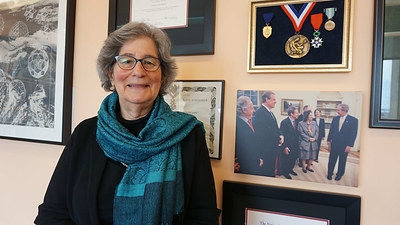
Climate change is one of the most urgent issues facing global sustainable development today. Professor Solomon is world-acclaimed for her seminal work on ozone layer depletion and climate change. By combining Antarctic field research, modeling innovations, and deep engagement with policy and the public, she has played a pivotal role in both the success of the Montreal Protocol and global climate negotiations. Her major contributions include proving that chlorofluorocarbons (CFCs) were indeed the cause of the widening ozone hole in Antarctica; proposing the heterogeneous chemical reactions that explain ozone hole formation; demonstrating that the impacts of CO₂ emissions are largely irreversible for more than 1000 years; and co-leading the production of the United Nations Intergovernmental Panel on Climate Change (IPCC)'s Fourth Assessment Report on the Physical Science Basis of Climate Change, which comprehensively synthesized key knowledge in climate science.
Professor Solomon is currently the Lee and Geraldine Martin Professor of Environmental Studies in the Department of Earth, Atmospheric and Planetary Sciences at the Massachusetts Institute of Technology (MIT). She began her scientific career at the National Oceanic and Atmospheric Administration (NOAA), where she served for 30 years before joining MIT in 2012. Over the course of her career, she has received nearly 70 international awards and honors, including the U.S. National Medal of Science, the U.S. National Academy of Sciences Award for Chemistry in Service to Society, and the Blue Planet Prize. Her receipt of the Tang Prize comes exactly forty years after she first led expeditions to Antarctica in 1986.
About the Tang Prize
Since the advent of globalization, humanity has enjoyed unprecedented benefits from advances in civilization and science. Yet a multitude of challenges, such as climate change, the emergence of new infectious diseases, the widening wealth gap, and moral degradation, have surfaced along the way. Against this backdrop, Dr. Samuel Yin established the Tang Prize in December 2012. It consists of four award categories: Sustainable Development, Biopharmaceutical Science, Sinology, and Rule of Law. Every two years, four independent and professional selection committees, comprising many internationally renowned experts, scholars, and Nobel laureates, choose Tang Prize laureates who have made substantive contributions and generated a far-reaching impact on the world, regardless of race, nationality, gender, or religion. A cash prize of NT$50 million (approximately US$1.6 million) is allocated to each category, with NT$10 million (approximately US$320,000) of it being a grant intended for research or educational outreach programs to encourage professionals in every field to examine mankind's most urgent needs in the 21st century, and become leading forces in the sustainable development of human society through their outstanding research outcomes and active civic engagement.
 View original content to download multimedia:https://www.prnewswire.co.uk/news-releases/atmospheric-chemist-susan-solomon-awarded-the-2026-tang-prize-in-sustainable-development-302800108.html

Die Schweiz stimmt an diesem Wochenende über eine der umstrittensten Initiativen der vergangenen Jahre ab: „Keine 10-Millionen-Schweiz!“. Der Vorstoß der nationalkonservativen Schweizerischen Volkspartei (SVP), auch bekannt als Schweizerische Volkspartei oder Swiss People's Party, sieht vor, die ständige Wohnbevölkerung des Landes bis 2050 auf maximal zehn Millionen Menschen zu begrenzen. Nach ersten Hochrechnungen tendieren die Stimmbürgerinnen und Stimmbürger dazu, die Initiative abzulehnen – ein Ergebnis, das im Vorfeld keineswegs sicher schien.
Die Initiative, die in der Verfassung verankert werden soll, würde den Bund verpflichten, Gegenmaßnahmen zu ergreifen, sobald die Bevölkerung 9,5 Millionen erreicht. Die Schweiz zählte Ende 2025 bereits gut 9,1 Millionen Einwohner – rund 1,7 Millionen mehr als 2002. Haupttreiber des Wachstums ist die Zuwanderung. Rund 28% der im Land lebenden Menschen besitzen keinen Schweizer Pass. Viele stammen aus EU-Staaten wie Italien, Deutschland und Portugal, hinzu kommen Personen aus Drittstaaten, darunter Asylsuchende.
Unterstützer der Initiative argumentieren, das Land stoße an seine Belastungsgrenzen. Sie verweisen auf steigende Mieten, überlastete Verkehrswege, Staus sowie eine als problematisch wahrgenommene Entwicklung bei Gewalt und Kriminalität, die sie mit einer höheren Zuwanderung verknüpfen. Ziel sei es laut Kampagnenmotto, „zu bewahren, was wir lieben“. Die SVP wirbt mit auffälligen Aufklebern, Fahnen und Plakaten in Nationalfarben, um eine Begrenzung des Bevölkerungswachstums als Schutz der Lebensqualität zu präsentieren.
Gegen die Initiative stellen sich der Bundesrat, das Parlament, die Kantone sowie die meisten übrigen großen Parteien, gestützt von Wirtschaftsverbänden und Gewerkschaften. Sie warnen, ein starres Bevölkerungs- und damit faktisches Zuwanderungslimit könne den bereits bestehenden Arbeitskräftemangel verschärfen. Laut Bundesamt für Statistik waren im ersten Quartal 2026 rund 1,87 Millionen ausländische Erwerbstätige in der Schweiz beschäftigt. Etwa vier von fünf kamen aus EU- oder EFTA-Staaten oder dem Vereinigten Königreich, der Rest aus Drittstaaten. Viele arbeiten in Bereichen wie Gesundheitswesen, Bau und Gastgewerbe – Sektoren, die stark auf Personal aus dem Ausland angewiesen sind.
Ein weiterer Konfliktpunkt ist das Verhältnis zur Europäischen Union. Die Initiative sieht vor, dass die Schweiz in letzter Konsequenz das Abkommen über die Personenfreizügigkeit mit der EU kündigen müsste, sollte die Obergrenze sonst nicht zu halten sein. Gegner befürchten, dies könnte die bilateralen Beziehungen und den Zugang zum europäischen Arbeitsmarkt belasten. Befürworter halten dem entgegen, nur mit klaren quantitativen Vorgaben lasse sich der Druck auf Wohnungsmarkt, Infrastruktur und öffentliche Dienste nachhaltig begrenzen.
Parallel zur Abstimmung über die 10-Millionen-Grenze entscheiden die Stimmberechtigten auch über eine Verschärfung des Zivildienstgesetzes. Im Fokus der innenpolitischen Debatte steht jedoch vor allem die Frage, wie die Schweiz Wachstum, Wohlstand und gesellschaftlichen Zusammenhalt künftig austarieren will. Das Ergebnis der Volksabstimmung dürfte zwar die Initiative selbst klären, die Grundsatzdiskussion über Zuwanderung, Arbeitskräftebedarf und Lebensqualität in der Alpenrepublik jedoch kaum beenden.