Delivering a unified infrastructure blueprint for scalable AI across compute, networking, memory and storage
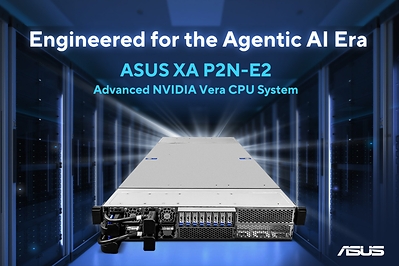
SAN JOSE, Calif., Oct. 12, 2026 /PRNewswire/ -- ASUS is expanding its AI infrastructure portfolio with the launch of the XA P2N-E2, a 2U NVIDIA MGX architecture-based server powered by NVIDIA Vera CPUs and designed for agentic AI and reinforcement learning workloads. Unveiled at OCP Global Summit 2026, this new ASUS server powered by the Vera CPU targets the execution layer of AI applications, handling workloads such as code execution, tool use, sandboxing, data processing and orchestration that extend beyond the AI model itself. The XA P2N-E2 supports up to two dual-slot NVIDIA RTX PRO 6000 Blackwell Server Edition GPUs, combining high-performance CPU computing with flexible GPU acceleration in a compact 2U platform. The high single-thread CPU performance and high-bandwidth, energy-efficient memory are designed to keep AI agents responsive during demanding execution and evaluation tasks.
At OCP, ASUS also showcases a broader portfolio covering rack-scale AI systems, accelerated computing, high-speed networking, context memory, low-latency inference and high-density storage. At the rack level, XA VR721-E3, the ASUS AI POD integrates 36 NVIDIA Vera CPUs and 72 NVIDIA Rubin GPUs through the NVIDIA Vera Rubin NVL72 platform, using a fully liquid-cooled architecture for large-scale AI training, post-training and inference. For a more flexible server configuration, the XR R1I12B-M1BHFS combines NVIDIA HGX Rubin NVL8 with direct-to-chip liquid cooling for the GPU baseboard and air cooling for Intel® Xeon® 6 processors. Together, the systems reflect the ASUS approach to scaling AI infrastructure across different compute densities, cooling architectures and deployment requirements, from individual servers to large-scale AI environments.
Building full-stack AI factories with the NVIDIA Vera Rubin Platform
ASUS is expanding its NVIDIA-accelerated portfolio across system and rack architectures, enabling customers to scale compute density, cooling and deployment models according to workload requirements. AI factory performance increasingly depends on more than accelerated computing alone. High-speed networking, scalable context memory, responsive inference and data infrastructure are all critical to maintaining efficient data movement and workload performance across increasingly complex AI environments.
Extending beyond the hardware stack, the NVIDIA DSXreferencedesign and NVIDIA OmniverseDSX Blueprint for AI Factory Digital Twins, part of NVIDIA DSXSim, bring validated architecture and high-fidelity simulation together, enabling physically accurate digital twins to optimize AI factory design and operations before deployment.
Four NVIDIA technologies featured at the ASUS booth bring together key elements of next-generation AI infrastructure. NVIDIA HGX Rubin NVL8 provides accelerated computing, joined by NVIDIA Spectrum-X Spectrum-6 based Ethernet switching for high-speed AI networking, NVIDIA CMX Context Memory Storage Platform for scalable context memory, and NVIDIA Groq 3 LPX, the interactive AI inference accelerator for NVIDIA Vera Rubin NVL72.
Designed for the low-latency and large-context requirements of agentic systems, NVIDIA Groq 3 LPX extends NVIDIA Vera Rubin NVL72 with ultrafast token generation for highly responsive inference. Together, these systems reflect the ASUS approach to building scalable AI factories based on the NVIDIA Vera Rubin platform, combining standardized, modular infrastructure across compute, networking, context memory, inference and storage. This full-stack architecture enables customers to scale AI infrastructure from individual systems to rack-scale deployments while optimizing performance per watt and accelerating time to production.
Push beyond limits with agentic AI servers powered by Intel Xeon 6 processors
Dedicated Intel and AMD showcase areas further enhance the capabilities of ASUS platforms, enabling customers to select architectures tailored to diverse requirements across cloud computing, AI and high-performance computing.
The Intel showcase features ASUS RS700-E12-RS4U and RS720-E12-RS12U, powered by Intel Xeon 6 processors in 1U and 2U dual-socket platforms. Their DC-MHS designs and tool-less serviceability enable modular deployment and streamlined maintenance, with flexible storage and expansion options for agentic AI, virtualization and data-intensive workloads.
Expanding architectural choice with AMD EPYC 9006 and Instinct platforms
The AMD showcase introduces the ASUS RS700A-E14B-R16U, powered by 6th Gen AMD EPYC 9006-series processors, codenamed 'Venice'. Designed for enterprise-grade resilience, this 1U dual-socket platform combines DC-MHS architecture with PCIe® 6.0 connectivity and support for up to 16 E3.S drives, addressing compute- and data-intensive infrastructure requirements. Complementing their high-density design, ASUS Thermal Radar 3.0 provides advanced thermal monitoring and management to optimize air-cooling efficiency, helping maintain system stability and performance under demanding workloads while improving overall data center thermal management.
For accelerated AI, ASUS ESC8000A-E13P supports AMD Instinct MI350P PCIe accelerators, while XA AM3A-E13 integrates eight AMD Instinct MI355X accelerators in a 10U design. With support for air cooling across both CPU and GPU components, XA AM3A-E13 enables high-density AI deployments without requiring dedicated chilled-water infrastructure, offering greater deployment flexibility while maintaining scalability and serviceability for demanding AI and HPC workloads.
Across OCP Global Summit 2026, ASUS brings together system and rack-scale engineering, accelerated computing, networking and storage with leading technology platforms to provide flexible infrastructure for a broad spectrum of AI, cloud and HPC workloads. This integrated portfolio enables organizations to align compute architecture, data infrastructure and deployment models with evolving performance and scalability requirements.
Visitors can experience the complete ASUS AI infrastructure portfolio at ASUS Booth #B9 during OCP Global Summit 2026.
AVAILABILITY & PRICING
ASUS servers are available worldwide. Availability of individual products and configurations may vary by region. Please contact your local ASUS representative for further information.
 View original content to download multimedia:https://www.prnewswire.co.uk/news-releases/asus-unveils-xa-p2n-e2-powered-by-nvidia-vera-cpu-for-agentic-ai-workloads-at-ocp-2026-302905807.html

Das Schweizer Studio Urban Games bringt seine erfolgreiche Verkehrssimulation in die nächste Runde: Transport Fever 3 ist ab sofort erhältlich – erstmals auch in einer Version für macOS. Spielerinnen und Spieler bauen darin über mehr als 125 Jahre Transportgeschichte hinweg ein eigenes Verkehrs- und Logistikimperium auf, von den ersten Pferdekutschen und Dampflokomotiven bis hin zu modernen Düsenjets, Supertankern, Hochgeschwindigkeitszügen und Helikoptern. Der Titel setzt damit die Tradition von Genre-Klassikern wie Transport Tycoon fort und positioniert sich erneut als Konkurrenz zu Städten-Simulationen wie Cities: Skylines, allerdings mit klarem Fokus auf Transport und industrielle Verknüpfungen.
Auf dem Mac richtet sich Transport Fever 3 klar an Besitzer aktueller Hardware. Urban Games verlangt mindestens einen M2‑Pro‑Chip, 16 Gigabyte Arbeitsspeicher, 90 Gigabyte freien Speicherplatz und macOS Sequoia 15. Empfohlen wird ein M4 Pro oder besser mit mindestens 24 Gigabyte RAM. Vertrieben wird das Spiel über Steam und GOG, die Einstiegsversion kostet ab 49,99 Euro. Ob zusätzlich eine Veröffentlichung im Mac App Store geplant ist, ist noch offen. Die Simulation bietet eine deutschsprachige Benutzeroberfläche und Vertonung; Videoeinblicke in das Spiel stellt der Entwickler auf YouTube bereit.
Inhaltlich bleibt Transport Fever 3 dem Kern des Genres treu, vertieft aber die Komplexität. Spieler verbinden Städte und Industrie-Standorte, organisieren Linien für Busse, Straßenbahnen, Lkw, Eisenbahnen, Schiffe, Flugzeuge und Helikopter und optimieren so den Transport von Personen und Gütern. Einnahmen generieren alle Transporte, doch zugleich steigen mit jedem Fahrzeug und jeder neuen Strecke die laufenden Kosten. Zusätzlich müssen mehrstufige Produktionsketten bedacht werden: Rohstoffe wie Holz gelangen zunächst ins Sägewerk, bevor sie als weiterverarbeitetes Produkt in die Städte geliefert werden. Fehler in der Planung oder ungenaue Umsetzung können dazu führen, dass sich Systeme gegenseitig blockieren – etwa bei langen Verbindungen über mehrere Kilometer oder im dicht getakteten innerstädtischen Verkehr.
Transport Fever 3 adressiert diese Komplexität mit einem stärker geführten Einstieg und Szenarien. Eine Einführung erläutert Schritt für Schritt grundlegende Mechaniken wie Straßenbau, Linienplanung und Fahrzeugkauf. Spezielle Szenarien führen anschließend in kompakter Form durch komplexere Zusammenhänge und setzen auf abgeschlossene, erzählerisch eingebettete Aufgaben – etwa wenn eine Stadt für einen Großanlass wie Mardi Gras vorbereitet oder ein Dorf bei der wirtschaftlichen Entwicklung unterstützt werden soll. Das Spiel legt dabei Wert auf Detailsteuerung bis hin zu Ampelphasen an Kreuzungen und erlaubt es, ein fein verzweigtes Netz aufzubauen, in dem erfahrene Spieler jede Linie und jeden Zug kennen. Besitzer von Transport Fever 2 erhalten beim Kauf der Standard- oder Deluxe-Edition auf derselben Plattform einen Treuerabatt von 10 Prozent – ein Angebot, das die bestehende Community in die neue Version mitnehmen soll.